

Big Food is treading the same road Big Tobacco took in the past when it comes to fighting public health policies with litigation.
A new investigation from nonprofit Lighthouse Reports, co-produced with a collection of media outlets across four continents, recently alleged that Coca-Cola, PepsiCo, and other major food and beverage companies are, as The Guardian put it, “taking governments to court to overturn, weaken or delay the policies.”
The strategy isn’t new to anyone familiar with Big Tobacco’s tactics over the last few decades.
“We’ve known about the harms of tobacco for a good 75 years or so, and for quite a few of those decades, the tobacco industry was doing the sort of things we’re seeing today, including bringing lawsuits,” UNICEF legal specialist Katherine Shats said during a live webinar this week discussing the Lighthouse investigation.
At the heart of the investigation are ultra-processed foods (UPFs), many of which are linked to heart disease, obesity (including childhood obesity), type 2 diabetes, and various cancers.
Currently, the individual consumer is submerged in what Shats called “unhealthy food environments” that are fueled by the ultra-processed food industry and large food and beverage companies “that want to make a profit and that want to make unhealthy foods the easiest, the cheapest, and the most appealing option for children and families.”
During this week’s webinar, she noted that the way to create meaningful change is to alter the legal landscape in which food and beverage companies operate through the passing of UPF-focused laws and regulations. Think taxes on sugary drinks or laws that require front-of-pack disclosures on high-salt food items, to name a couple examples.
“Ultimately, laws are what shape social norms and business practices,” she said.

A familiar corporate playbook
Over the last 10 years—the time period for which the investigation took place—major food and beverage companies have fought against such laws at the same time they say they want to be part of the solution, according to the Lighthouse investigation.
It isn’t one single tactic. As Shats outlined during the webinar, interference from food and beverage companies can happen at any stage of the policy cycle, from early efforts to contest proven science to promoting disinformation in the media, promoting policy alternatives, lobbying, and lawsuits.
“This is really part of a corporate playbook that we’re very familiar with,” she added.
Tobacco companies pursued much the same strategy for decades, including arguing that the industry should be part of the solution and sit at the policy-making table.
Big Tobacco’s strategy ultimately faltered. Lawsuits fell apart in courts, governments moved forward with strong tobacco control laws and policies, and smoking rates subsequently fell.
“Very importantly, tobacco companies are, on the whole, no longer viewed as legitimate partners in public policy making, and so we can learn a lot when we start to look at food policy as well,” said Shats.
“If we look at the strategies and the patterns of legal stalling, the parallels are not coincidental; they are structural,” added Thin Lei Win, a lead reporter for Lighthouse Reports who authored much of the report.
Echoing Shats, she pointed out that tobacco companies are no longer partners when it comes to making public health policies.
“Does the food and beverage sector want to go down the same route? After all, it is in your best interest that we are healthy, that we can continue to consume your products.”
Investigation findings
Lighthouse Reports worked with newsrooms across four continents, with partners in Brazil, Colombia, Mexico, Netherlands, UK, Italy, the US, and India. Among the investigation’s major findings:
- There were 239 lawsuits filed against public health policies by major food and beverage companies between 2010 and 2025 in Mexico, Colombia, Brazil, the US, the UK, and India.
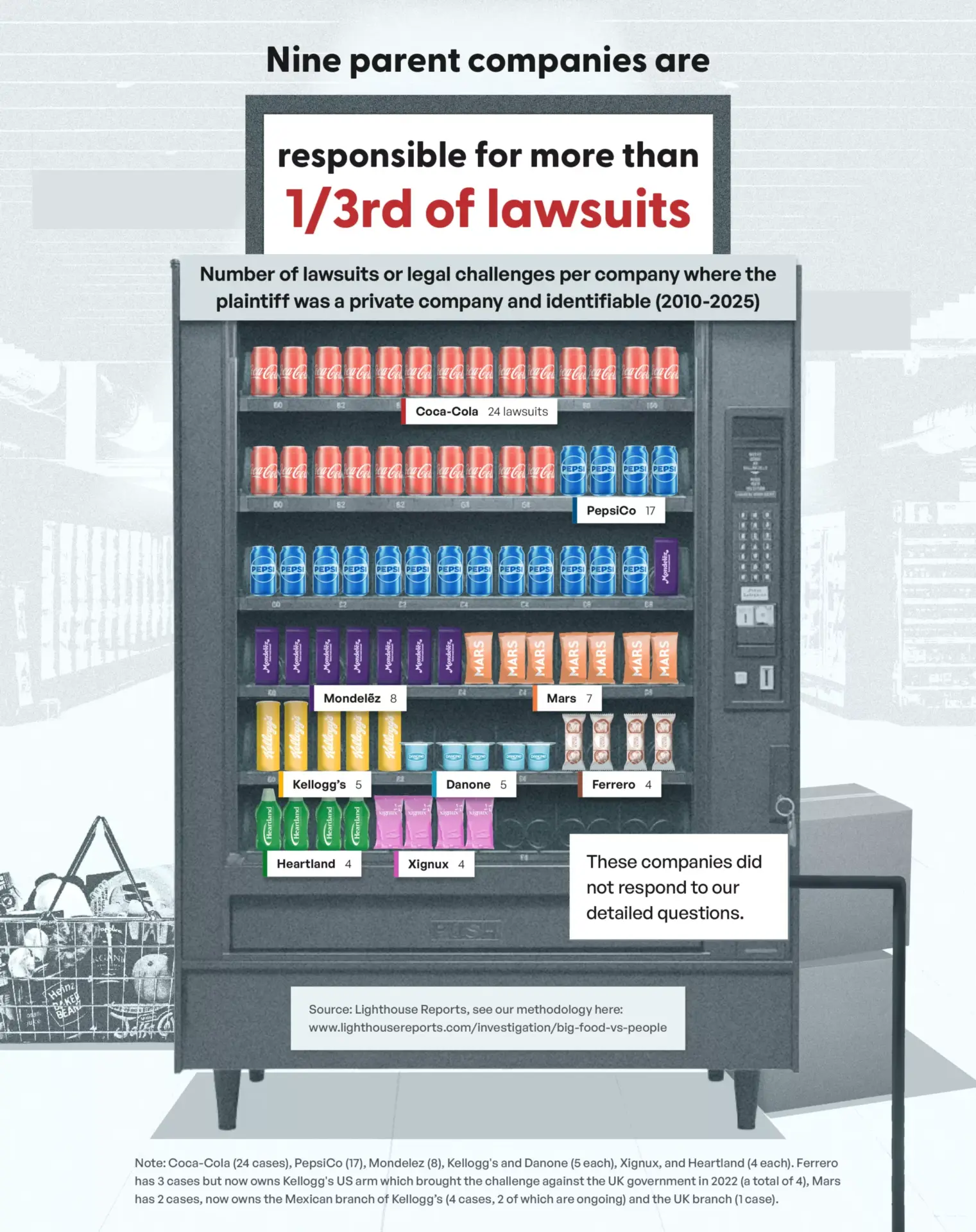
- Nine parent companies are responsible for more than a third of those lawsuits. Coca-Cola and PepsiCo represent the most lawsuits by far, 24 and 17, respectively. (The investigation notes that plaintiffs could not be identified in some of the lawsuits.)
- The majority of lawsuits are related to front-of-pack labeling, regulating advertising junk food to children, soda taxes, and taxes on ultra-processed foods.
- Big Food lost 82% of cases between 2010 and 2025 but still tied up public resources, leading to delays with enacting laws and policies.
- The investigation team found the most lawsuits in Mexico: 193 out of 239, or 8 out of 10. The majority of these suits are against labeling regulations, which food companies claim are a “violation of their constitutional rights.“
- Some of the 17 lawsuits in Brazil have been ongoing for nearly two decades with no end in sight. For many of these plaintiffs, many of which are industry associations that include large food companies in their membership, they are fighting laws that would require more labeling information on low-nutrition foods and beverages.
Win notes that the investigation team reached out to food companies for comment and “heard back from very few of them.” She added that responses were mostly “short and didn’t address many of our queries.”
Coca-Cola, Ferrero, and Danone provided statements which The Guardian has incorporated into its coverage.
‘Legal threats shouldn’t deter action’
Win also claimed that the investigation “shows that litigation is being used as a systemic tool to freeze public health policies.”
She encouraged governments to “move beyond rhetoric” and “legislate on public health interests, not the industry.” She went on to name academics, public health institutes, and civil society organizations as important voices with counter narratives, and highlighted the individual consumer as “a critical component of food equity.”
Shats said one way to do that is by creating policies with clear public-health objectives and strong evidence bases that are free from conflicts of interest.
“There can be consultation processes that are done transparently, but industry cannot be part of the policy design.”
“A lawsuit does not mean that a measure is unlawful. In fact, it usually means the opposite-that it’s commercially consequential. It’s helping the industry achieve its goals, and it’s going to go against what we want from a public health perspective, which is of course to protect lives and protect public health,” she added.
“Legal threats shouldn’t deter action. What they really tell us is that regulated industries cannot be part of the solution, they cannot be seen as a legitimate partner, as a legitimate voice, but also that legal threats should be anticipated but not feared. We know what the arguments are; we can anticipate them because they’re the same every time, and we know how to respond.”

Sign up for our weekly newsletter.