
A few years ago, a widely cited study said climate change would make beer taste worse and cost more in the future thanks to warmer, drier weather impacting hops production. That risk hasn’t gone away, and for brewers, a steady supply of hops is what makes beers distinctive and keeps drinkers coming back
“Brands don’t want to risk that,” says Ines Sagrario, CEO and cofounder of Ekonoke.
One solution: grow hops indoors, ideally next door to the brewery itself. That’s exactly what Sagrario and her team at Spain-based Ekonoke are doing.
Ekonoke started life as a leafy greens operation, but shifted gears long before that part of indoor agriculture started its brutal and ongoing correction.
“The market wasn’t really responding as we had planned. There was considerable price sensitivity and we weren’t able to produce competitively, especially in a place like Spain, where local produce doesn’t need to travel thousands of kilometers.”
Hops were a different story.
“In the case of an essential ingredient with a climate risk, we see that brewers would be okay in paying twice the price so that they don’t need to change the flavor of their brand. If that cultivar of hops is no longer available outdoors, they’re going to change that flavor. And consumers are very loyal to flavors.”
Local production, less risk
Ekonoke grows its hops via a customized vertical farming system using equipment from SIEMENS, the company’s official technology partner.
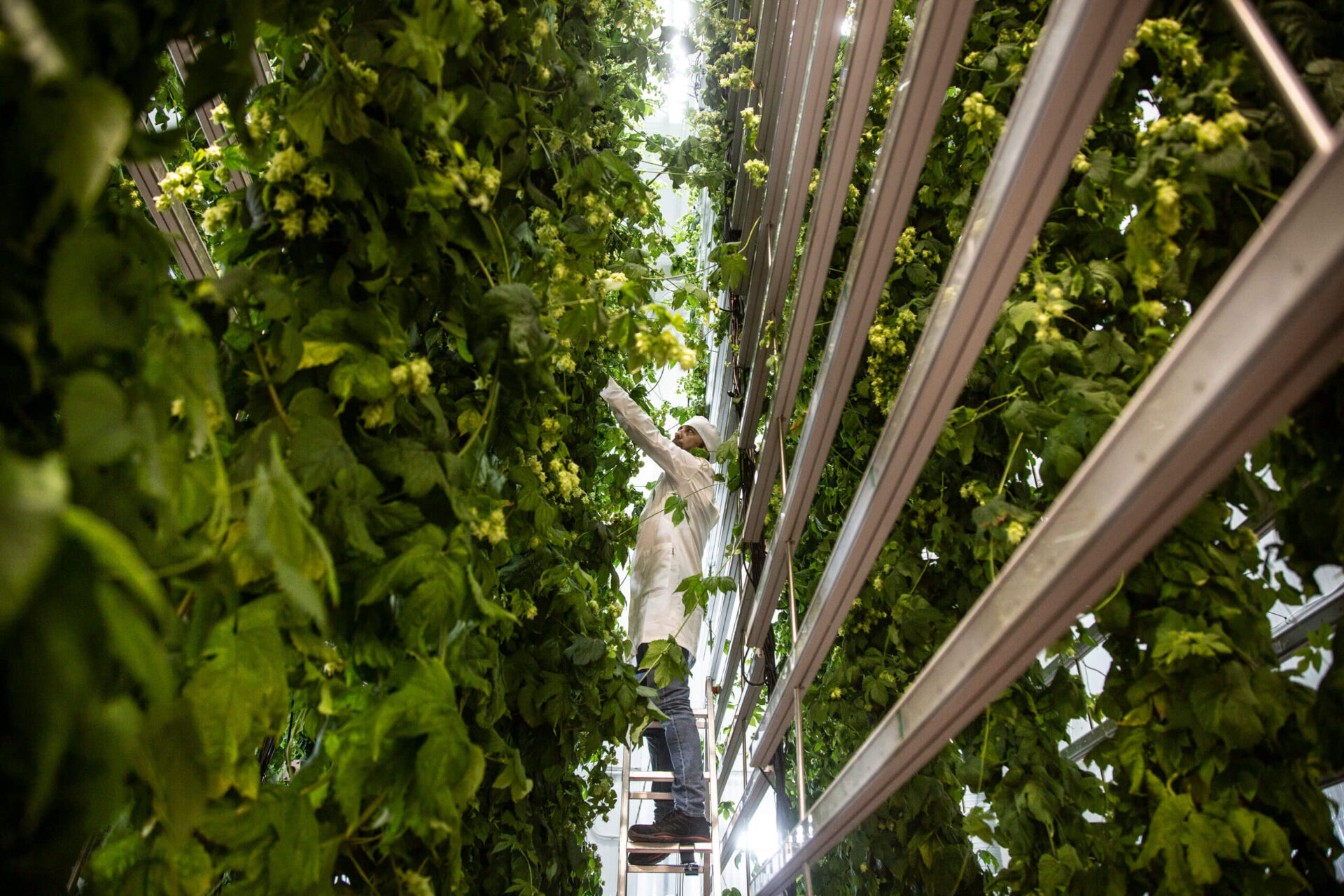
As with outdoor production, hops inside Ekonoke’s farm grow vertically, wrapping around trellis-like structures that climb eight to 10 meters high.
The process is significantly more complex than growing leafy greens indoors, says Sagrario. In addition to longer crop cycles, the process requires constant updates to the nutrient formula pumped to the plants, based on the stage of the crop. Humidification control is also a constant challenge, since hops are large plants that become “water-generating machines” when fully grown, she adds.
The Ekonoke business model is to build indoor hop farms for clients, ideally near the latter’s own brewing facilities, to ensure a steady, local supply of hops.
The model relies on long-term contracts where the clients (brewers) supply the investment for the infrastructure up front and Ekonoke runs the farms, providing brewers with hops for a set number of years. Sagrario likens the structure to a solar offtake agreement, where a buyer purchases electricity for a fixed period of time from the project developer.
For example, Ekonoke’s most high-profile partnership thus far is a 20-year contract with Cosecha de Galicia, the innovation arm of Spanish brewing company Hijos de Rivera. The Ekonoke team runs a pilot-scale facility that supplies the hops for local beer production in the north-west Galicia region of Spain.
“What we’re building is more expensive than having farms for hops outdoors, but it’s also less risky because we can guarantee you’re going to be able to reliably produce what you need,” explains Sagrario.
Slow-but-steady expansion
The company hopes to soon evolve to industrial-scale production, which will require a facility around 11,000–12,000 square meters. Sagrario says expanding to additional locations will be based on “clients that may be interested in sourcing their own hops.”
Ekonoke is already in discussions with other international brewers interested in both guaranteeing supply of hops and improving the environmental impact of their sourcing.
“We have a lot of support from Hijos de Rivera, and they’re a major shareholder in the company. Last year we brought in new shareholders from Japan,” says Sagrario.
She adds that growth is slow-but-steady, with Ekonoke currently focused on validating KPIs before any major scaling happens.
“We want to make sure that what we’re doing is scalable before we bring any more money. That’s probably going to take us another year. Series B will be by the end of 2027, once we have a clearer picture of what’s working.”