
The planetary boundaries framework rarely has a part to play in traditional, GDP-obsessed economics. That’s fast changing, though, as the planet’s finite resources become more apparent each year. Figuring out how to do business within Earth’s operating systems is a growing priority for many businesses.
To that end, “building prosperity within planetary boundaries” is a key theme at the World Economic Forum in Davos, in full swing this week.
In a nutshell, the concept invites leaders to reshape the concept of prosperity within planetary boundaries by investing in and advancing new energy, nature, and water systems.
But what exactly are planetary boundaries and planetary health? And why do they matter when it comes to doing business? Read on for a quick primer.
What is planetary health?
In its frequently cited 2015 report on the concept, The Rockefeller Foundation-Lancet Commission defined planetary health as “the health of human civilization and the state of the natural systems on which it depends.” (The original report also contains a more detailed definition.)
In a nutshell, human health is inherently connected to and reliant on the natural world, the source of necessities such as food, fuel, and water. An unhealthy earth leads to unhealthy people—physically, mentally, socially, and geopolitically speaking.
As we’ll see below, unhealthy people could cost the global economy trillions.
What are planetary boundaries?
“Planetary boundaries” were introduced in 2009 by the Stockholm Resilience Centre. (An update followed in 2020.) They are essentially a framework for “estimating a safe operating space for humanity with respect to the functioning of the Earth System.”
Or as the Planetary Health Check puts it, these are “scientifically defined guardrails that ensure the Earth’s health.”
These nine interdependent boundaries work together to keep the Earth’s stability and resiliency intact.
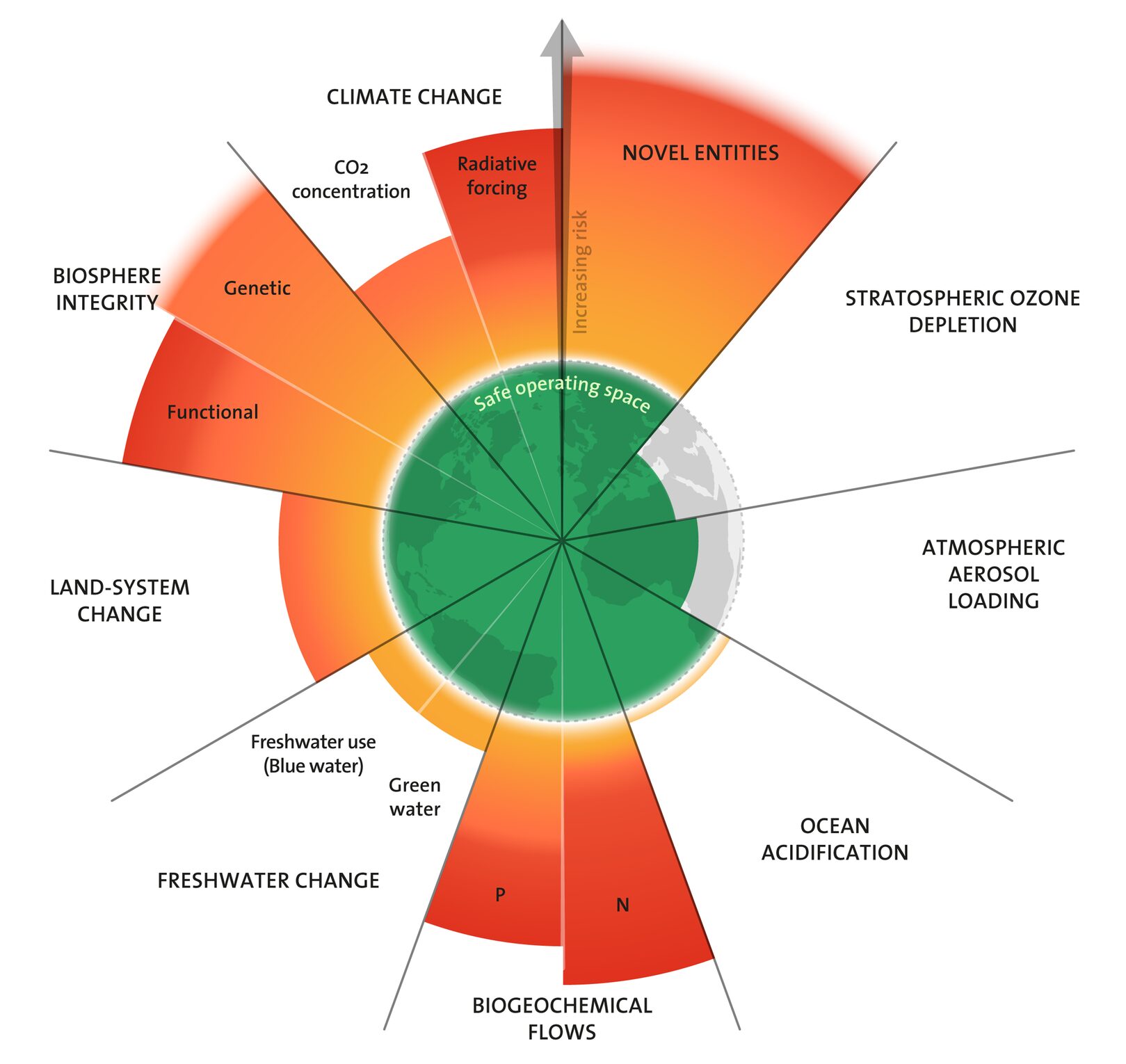
For example, healthy soils retain water, filter out pollutants, enable biodiversity both above and below ground, and cycle nutrients that eventually wind up in crops. When those soils are damaged through things like overuse of chemical inputs or over-grazing (to name just a couple), the consequences can be as far reaching as the ozone layer.
We’ve now breached seven of the nine boundaries.
Why do planetary boundaries matter?
Just as guardrails on a highway keep cars securely on the road, planetary health boundaries guard the point between a safely operating planet and one in “high risk” territory that puts human health in jeopardy.
“Human beings live within a safe operating space of planetary existence,” notes the Rockefeller/Lancet report. “If the boundaries of that space are breached, the conditions for our survival will be diminished.”
The consequences of environmental degradation have even led some to call the climate crisis a public health crisis.
But in 2026, many now recognize the danger of an economic crisis, too. According to a recent report from the World Economic Forum:
- Climate-driven health risks could cost the global economy $1.5 trillion in lost productivity by 2050.
- In food and agriculture, these impacts could lead to $740 billion in lost output and impact food security.
- Health and healthcare will lose an estimated $200 billion in productivity on account of “workforce climate health illness.”
- The insurance industry is expected to see “a sharp rise in climate health claims.”
“We have very strong signs that we’re moving closer to tipping points which can lead to irreversible changes that would undermine more or less permanently the basis upon which economic development depends,” noted Johan Rockström, director of the Potsdam Institute for Climate Impact Research, said at WEF’s 2025 Sustainable Impact Development Meetings in September.
Can technology help?
The short answer is yes, particularly in industries like agriculture, construction, energy, and manufacturing.
WEF recently spotlighted several technologies that could help restore some of the planet’s fundamental processes. Among those related to food and agriculture:
- Precision fermentation can produce meat and dairy analogues without actual livestock. It’s high on the list of agrifoodtech areas investors are watching closely right now.
- Green ammonia production could go far in decarbonizing agriculture produce ammonia electrochemically and onsite at farms, replacing the fossil-fuel-heavy Haber-Bosch process.
- Automated food-waste upcycling technologies could make it easier to divert food from other waste, enabling more composting or turning material into biogas and bioplastics.
- Methane capture from landfills, manure, and other places could sequester more CO2 in future.
- “Timely and specific Earth observation” via satellites, ground sensors and drones can monitor soil health, deforestation, and water levels.
- Soil health technology convergence combines sensors with microbial engineering and AI to reduce farm emissions and fertilizer usage, in addition to improving crop yields.
During a panel at Davos this week, André Hoffmann, vice chairman of Roche Holding and interim cochair of WEF, minced no words in discussing the importance of planetary health as part of the global economy: More than half of all global GDP depends on nature.
“If you have no nature, you have no humanity, you have no business, you have no dividend, you have no shareholders.”

Sign up for our weekly newsletter.