Gabe Youtsey is the chief innovation officer at the University of California Agriculture and Natural Resources.
The views expressed in this article are the author’s own and do not necessarily represent those of AgFunderNews.
The infrastructure decisions made in the next 18 months will shape agricultural innovation for decades.
Discovery will continue to accelerate, and venture capital will continue to fund companies where the return profile works. But without shared infrastructure that lowers the cost, time, and risks of scaling up, too many urgent agricultural technologies will remain unattractive to private capital, no matter how important they are to farmers, climate resilience, or food security.
The success of any transformative technology depends on a bridge between invention and the infrastructure to support it. Electricity needed the grid. Biotechnology required shared manufacturing capacity, regulatory science, and institutions willing to invest long before markets matured.
Agricultural biology is now approaching that bridge.
I have spent nearly two decades inside the University of California’s agricultural research system, and the most astounding part of the last five years has been the pace of development in upstream science.
The convergence of AI-assisted strain design, microbiome research, metabolomics, and synthetic biology has produced a discovery curve that surprises even long-timers in the field. We now have biological tools that, in specific crops and contexts, can replace or reduce reliance on synthetic fertilizers and pesticides. We have crops designed to use measurably less water without yield loss, and we now can, in granular detail, characterize what soil microbial communities are actually doing in real fields.
But with agriculture, an innovation must survive several phases before it creates any real impact. A biological, seed trait, or food ingredient must work in the laboratory, scale in manufacturing, perform in real fields and supply chains, clear regulatory review, and finally deliver value to both farmers and consumers.
This is a long journey, and currently there is a shortage of institutions designed to help ideas survive along the way. Without this scale-up infrastructure, more research funding simply produces more stranded innovation.
Stranded innovations mean lost impact
Every additional dollar invested in discovery now produces more candidate technologies than our infrastructure can move into commercial validation. Simply put, that means gap between what we know how to make and what a farmer can buy is widening, not closing, precisely because of our upstream success.
Consider a startup developing an ag biological product. A single pilot-scale validation campaign, whether for fermentation, formulation, processing, or field-scale demonstration, can cost an early-stage company between $500,000 and $1.5 million, and require a wait of 12 to 18 months in a private contract-manufacturing queue, if capacity can be found at all. The biological itself may have cleared the laboratory, but the impact is lost because the company cannot get into that large fermenter.
For farmers, this means innovations that could lift profitability, cut input costs, or build resilience arrive later than they should, if they arrive at all.
What the bioeconomy needs now is not another single biomanufacturing facility but a new category of shared infrastructure, one with a clear public mission, so that access is governed by creativity and readiness rather than ability to pay.
Nor is the payoff only financial. Both the environmental and economic value of an agricultural biological is realized only when it is produced reliably, adopted by farmers, and deployed across acres. A biological that reaches commercial production in five years instead of 10 delivers materially different cumulative emissions reductions, water savings, and soil-carbon gains.
Equally important are the materially earlier returns generated to the farmers who adopt the product and the rural economies that produce it. Every year a working technology spends stranded is a year of lost yield, lost margin, and lost ground in a global bioeconomy race that the United States cannot afford to cede.
This is the same logic that built the national laboratories and the semiconductor consortia: shared, public-purpose capacity assembled because private incentives alone would not assemble it.
Enabling invention to become infrastructure
California offers a compelling place to start. It combines the world’s most productive specialty crop agriculture, leading research universities, a dense concentration of food and biotechnology companies, and a statewide extension system capable of moving innovation into practice.
The University of California Agriculture and Natural Resources (UC ANR) is currently developing this open-access transition layer, called The Plant.
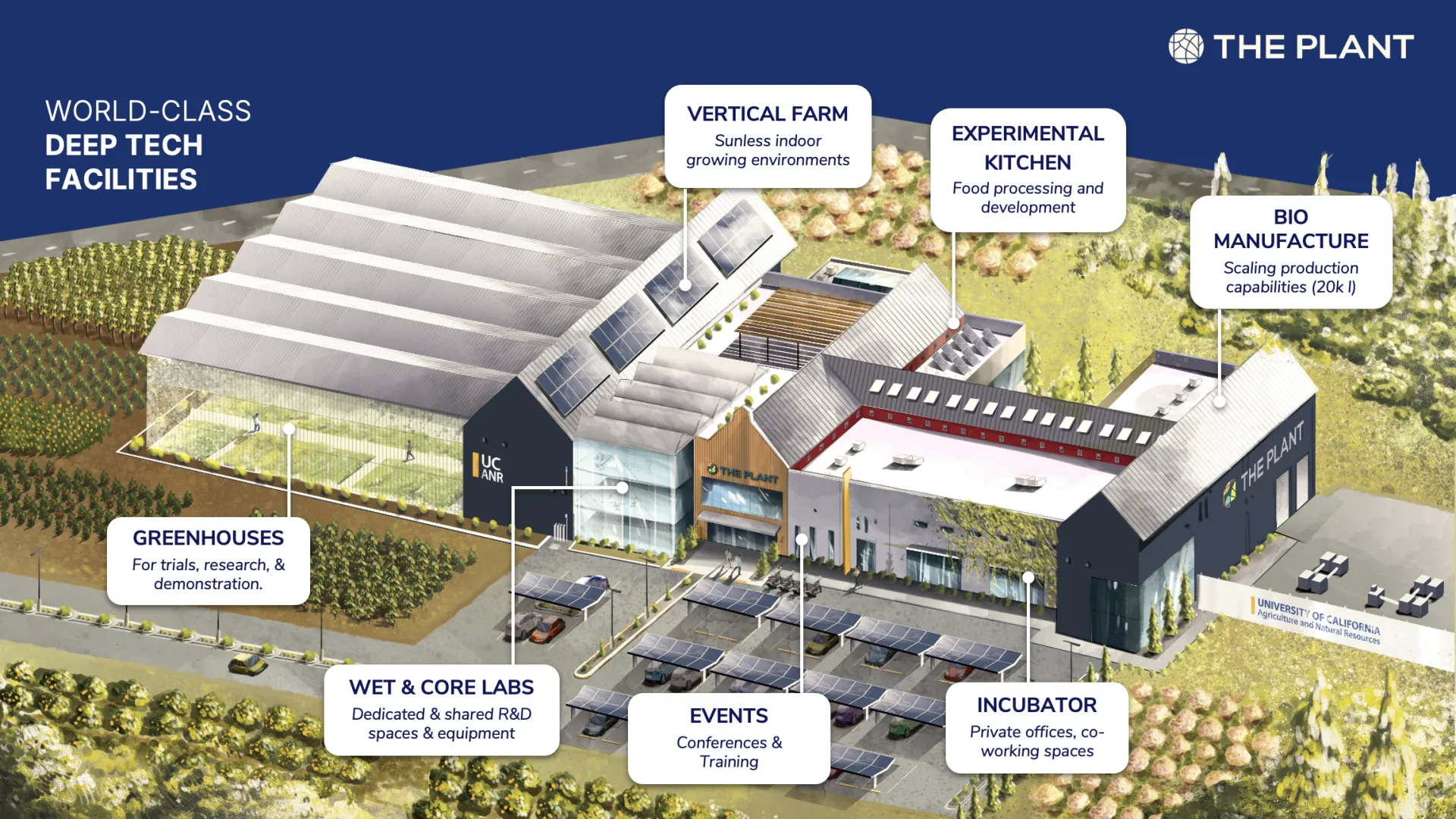
The Plant is an early example of what public-benefit translation infrastructure can look like: a world-class pilot-scale biomanufacturing facility in the Sacramento region, turned into shared public capacity.
The Plant connects, through UC ANR’s 58-county Cooperative Extension network, to every agricultural region in the state. Since the University of California publicly governs the facility, access stays open to mission-aligned innovators rather than being gated by commercial rates. It carries an integrated technical stack in one location: fermentation, downstream processing, formulation, analytical testing, and field validation, because pilot-scale validation requires capabilities that distributed alternatives cannot duplicate.
And it builds its own workforce because biological manufacturing is a technician economy, and the country is not yet producing enough trained operators for these facilities.
This is what makes translation infrastructure a different kind of investment. Unlike a grant to a single company or technology, a shared facility compounds across many innovations. One site can accelerate hundreds of biologicals, food technologies, and agricultural products over its lifetime, lowering the cost and risk of scale-up for every team that uses it. Philanthropy is at its best when it funds leverage: the shared infrastructure that lets many promising innovations, not just one, reach the people and markets they are meant to serve.
What remains uncertain is whether we will build the shared institutions that let those discoveries reach farmers, food producers, and consumers at a meaningful scale.
The lesson from electricity, semiconductors, biotechnology, and the internet is not simply that breakthrough technologies matter. It is that every transformative technology eventually becomes an infrastructure story. The organizations that built those bridges were rarely rewarded for a single invention. Their contribution was to create the conditions that enabled thousands of inventions to succeed.
Agricultural biology has reached that moment. The United States does not need one more breakthrough nearly as much as it needs the institutions that help breakthroughs survive the journey from laboratory to field.
Just as the agricultural experiment stations and Cooperative Extension have carried agricultural discovery into practice, the country will likely need many regional translation institutions over the coming decade, operated by universities, public-benefit organizations, and mission-driven partnerships that serve entire innovation ecosystems rather than individual firms.
The Plant is one example. It should not be the last.