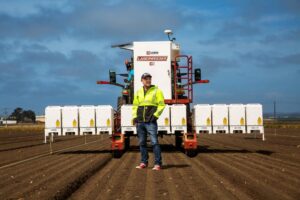
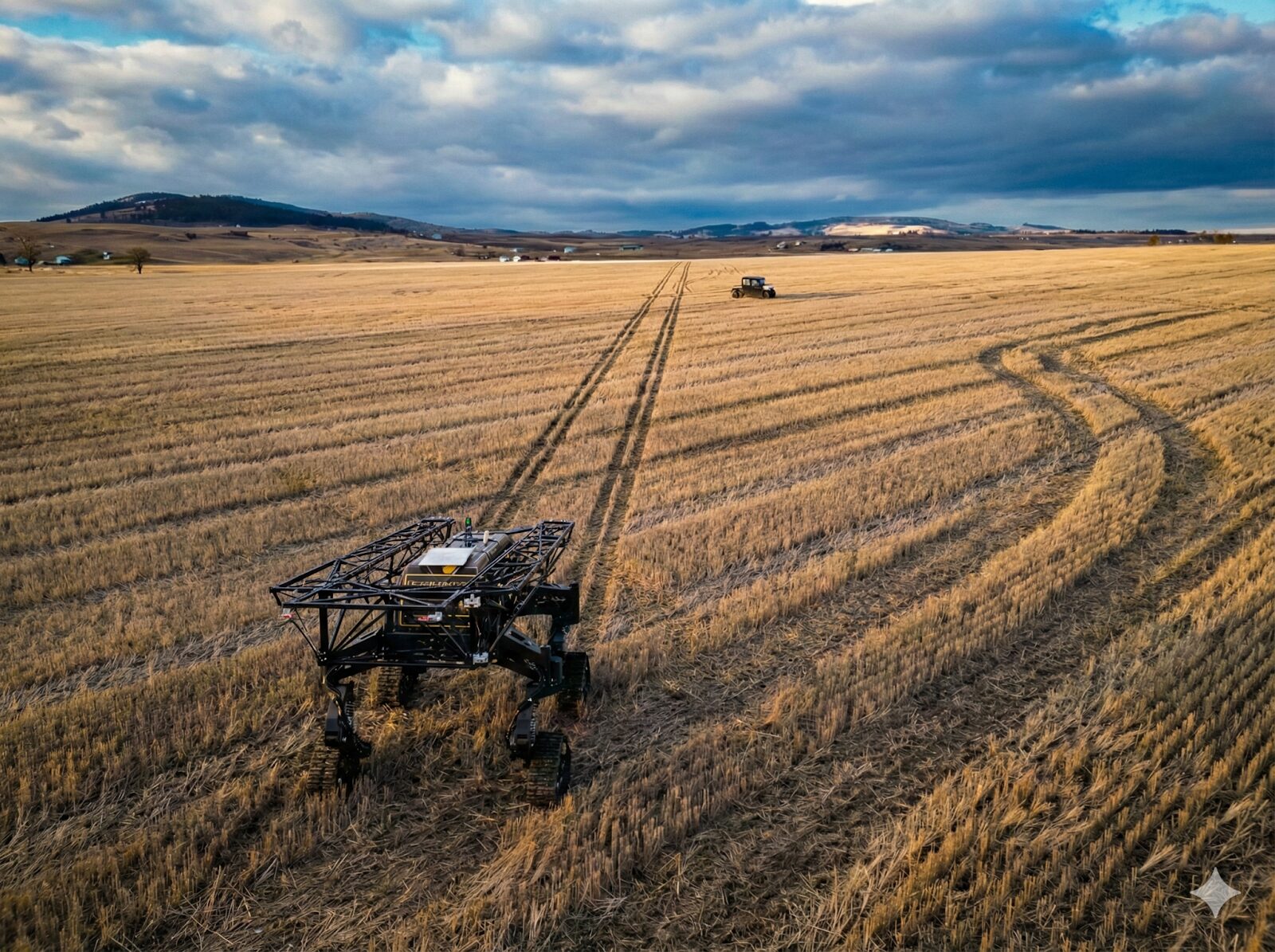
US-based TerraClear aims to make precision farming “technically and economically feasible” for growers with the launch of its fully autonomous robot TerraScout. The new machine enables autonomous image collection on the field for rock-mapping and weed identification, and can send “mission plans” in real time to other farm equipment for growers to act on quickly.
Importantly, the company is focused specifically on fields for broad-acre row crops.
“TerraScout will scout entire fields in almost any condition and convert that intelligence to precise action for existing crews and equipment,” explains CEO Devin Lammers. “Today we focus that output on rock and weed management, but the future applications for this platform are vast.”
One ‘bot, many uses
TerraClear initially offered AI-generated rock maps to help farmers locate and in some cases even remove rocks from the field (a necessary but typically loathed annual farm task). The company says it has mapped nearly 1 million acres over 1,000 farm operations, and can now also do AI-powered identification and management of weeds.
Thanks to its autonomy stack, TerraScout can:
- Map more than 1,000 acres per day moving at speeds of up to 15 miles per hour; a 60-foot mapping swath reduces the amount of turns the machine must make, increasing the number of acres mapped per hour.
- Collect more than 4 billion image samples per acre at 1 mm ground sample distance.
- Onboard edge-compute technology allows TerraScout to turn massive image datasets into actionable maps in real-time.
- Use perception navigation tools to avoid obstacles like animals.
- Enable row following—staying between rows of crops with precision to minimize soil compaction and avoid driving over the plants.
- Operate fully autonomously for up to six hours without refueling.
- Operate in most weather conditions and throughout the day and night.
Lammers, who joined TerraClear in 2024, tells AgFunderNews the company first caught his eye as “one of the first examples of a true end-to-end solution, all the way from data collection to really efficient action in the field.”
“The more I dug into the technology, even before I joined [the company], the more I developed confidence that the same technology stack developed for the rock side is extensible to many applications within agriculture.”
He notes that TerraClear is currently in conversations with seed and chemical manufacturers to explore other uses for TerraScout, including phenotyping.
Scaling for row crops
The vast majority of machines in ag robotics right now are geared towards specialty crops, which Lammers says makes sense given the higher revenue per acre.
“You can justify a pretty expensive piece of equipment. Also, labor is 30% to 40% of specialty crops’ cost, so a lot of robotics [in this area] is about automating labor.”
Broadacre row crops are a different story. Labor typically only accounts for 6% of costs, and the really valuable tools in this arena are those driving input efficiency and yield productivity, he says.
“The whole name of the game for row crops is productivity at low cost and high scale. If you can’t do that, you’re sunk.”
TerraClear has already proven itself at scale, he adds, noting that TerraScout machines will be mapping three quarters of a million acres this spring.
“Very few companies are taking true full field imagery, and almost nobody is at the level of resolution we’re doing for the cost that we can deploy. And so that combination of high fidelity data across the entire field at low cost and high productivity is is very, very rare, maybe non existent.”
Being able to extend that across a lot of applications is really useful, he adds.
“I think we find ourselves in a fairly unique sort of place where we can do multiple things, but also with an ROI that just already makes sense to growers.”
Field trials started earlier this year for TerraClear, with a limited release planned for fall 2026.