As anyone that has worked in a factory will know, watching a training video or reading an instruction manual is one thing. Doing the job is another.
In a small company with a handful of staff, new employees can job-shadow or simply ask for help. In a plant with 100-plus people, high staff turnover, multiple shifts and multiple languages, things are more challenging, says DeepSight cofounder Nicolas Bearzatto.
When knowledge lives in people’s heads rather than systems, high turnover, language barriers, and inconsistent training translate directly into slower ramp-up times, higher error rates, and costly downtime. DeepSight’s pitch is to capture that tribal knowledge once and deliver it back to workers as clear, visual, multilingual instructions—right on the factory floor.
Founded in Montreal in 2019 by Bearzatto and Francis Dubé, DeepSight began with an augmented-reality (AR) engine capable of visualizing and manipulating 3D models. Over time, it has evolved into a full knowledge-management and work-instruction platform for industrial environments, with a strong focus on food manufacturing.
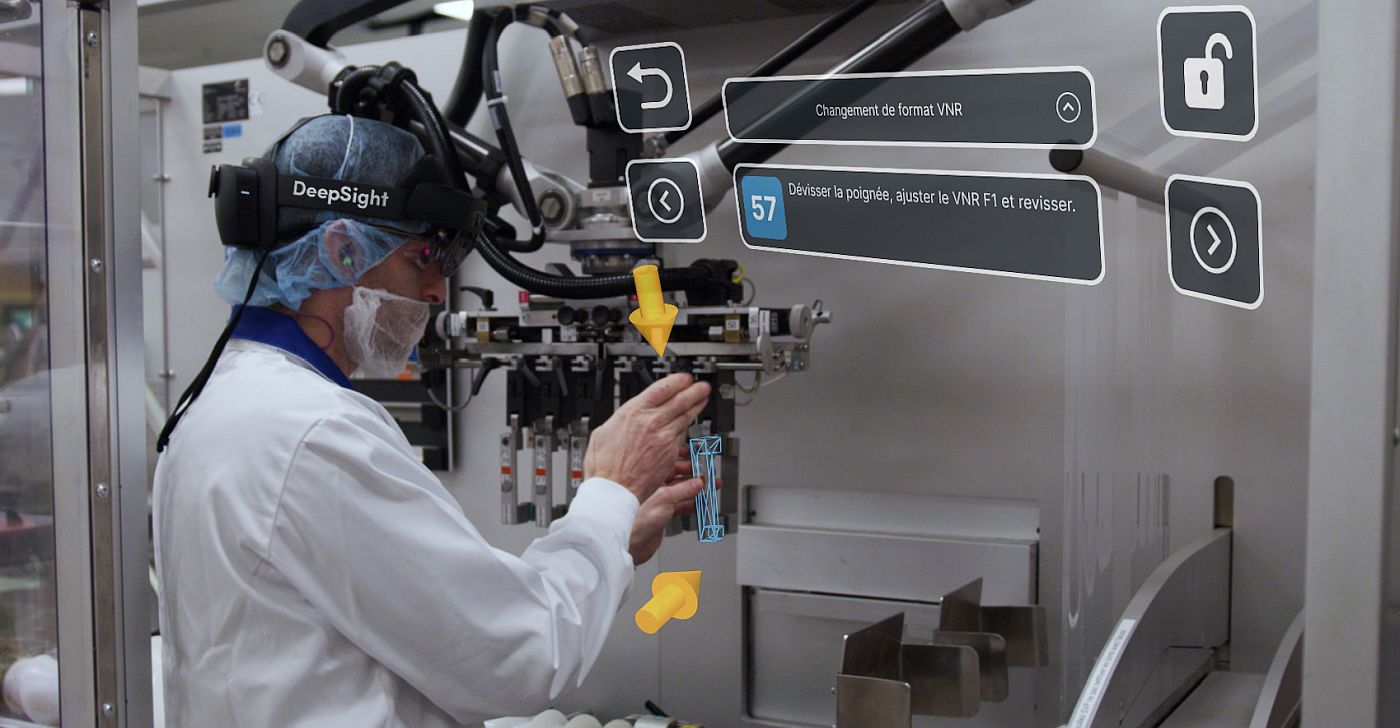
The core innovation is a rapid knowledge capture system that records experienced operators using smart glasses as they perform tasks, says Bearzatto. The system captures what they see, say, and do, then uses AI to synthesize this data into standardized, step-by-step digital work instructions in minutes.
“We were like, let’s take Joe or Bob… you know, that guy that has been in the company for 25 years that knows all the tricks, that knows how to use every machine, and he could retire in a couple months, and take all his knowledge with him.”
He adds: “Let’s have him put on the smart glasses and ask him to do the task or the test the way he does it normally, and we’re going to document everything: what he’s doing, what he’s seeing, what he’s telling us he’s doing, the position of his hands, his head, around the equipment.
“We then send these data to our AI that synthesizes it and gives us back a work instruction that is standardized step by step in a matter of minutes, which is a game changer. It’s digestible, interactive, visual, auditive.”
👉 Virtual reality (VR): Fully immersive—users wear a headset and the real world disappears, replaced by a completely digital environment.
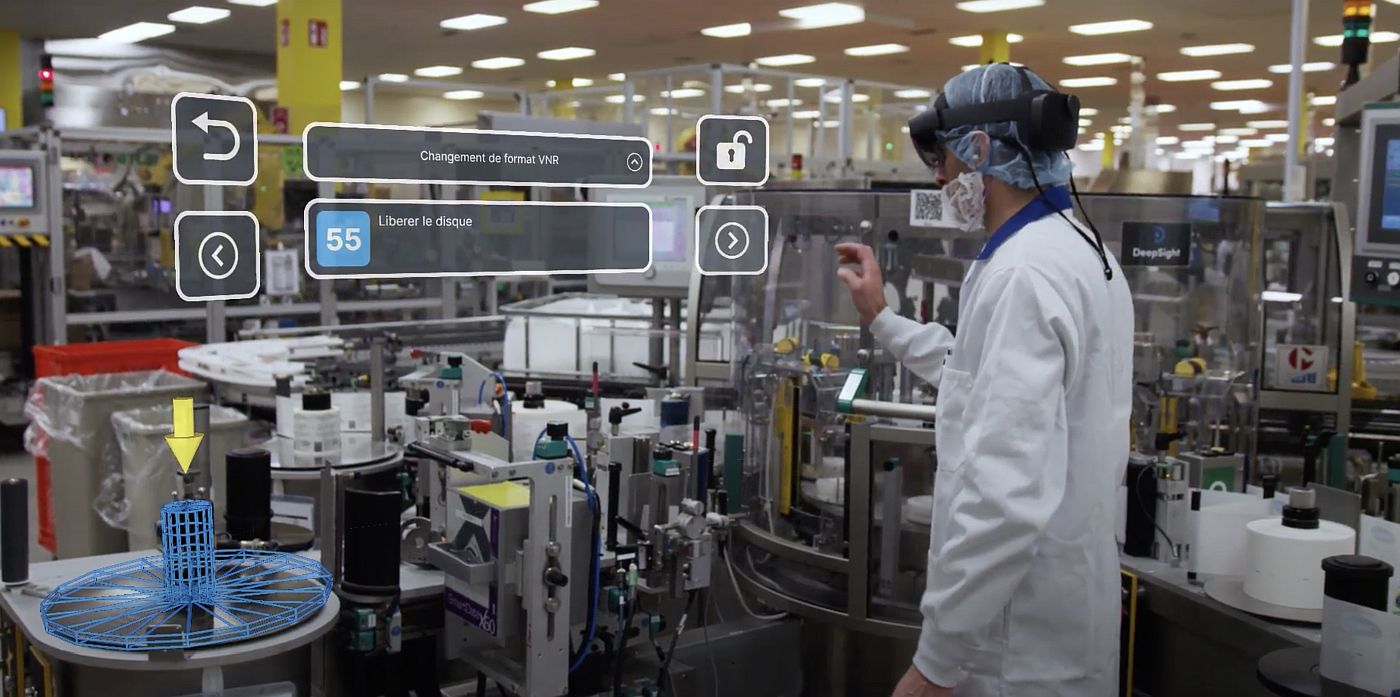
👉 Augmented reality (AR): Real-world + digital overlay—users see the physical environment with contextual graphics/instructions layered on top.
Guided, multilingual instructions—right where the work happens
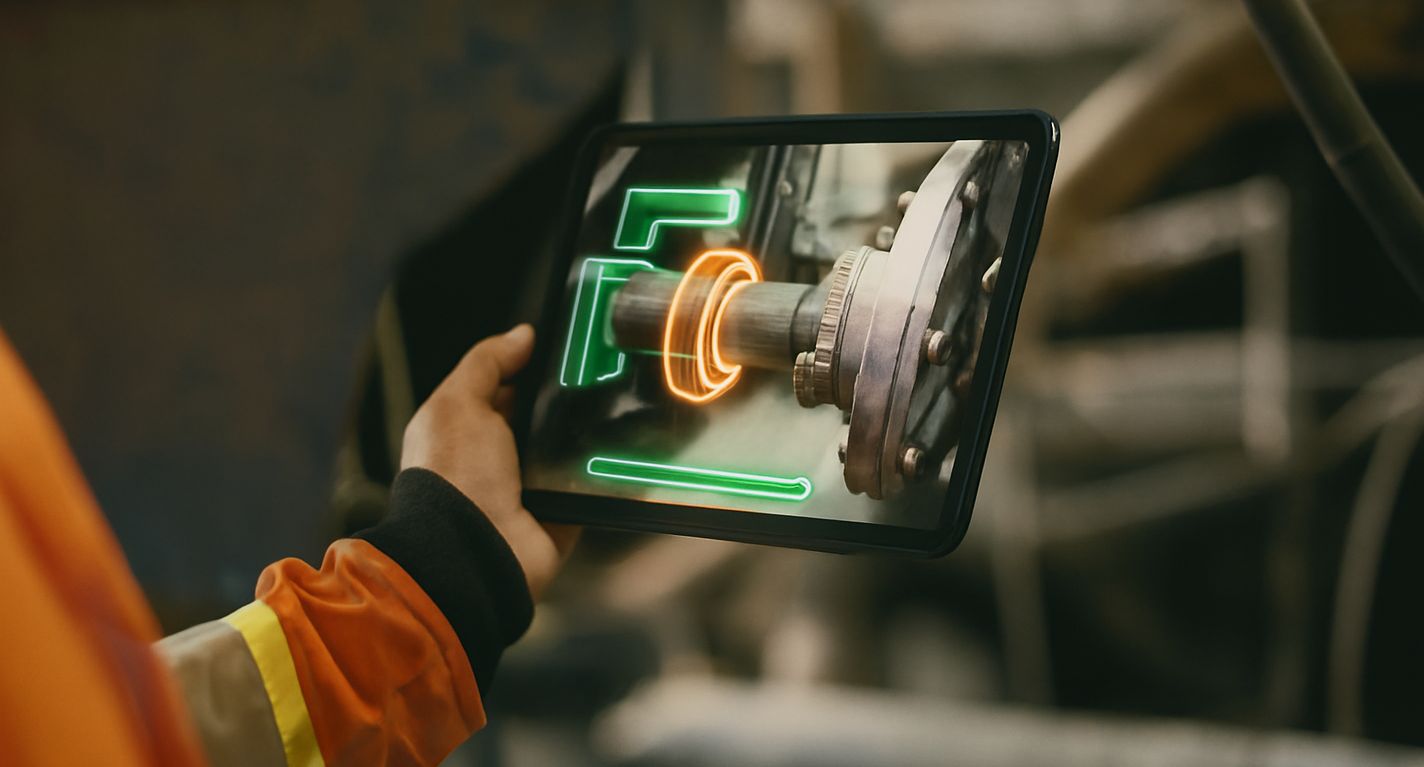
For end users, instructions can be delivered via AR smart glasses but more commonly by tablets, which many factories already use, says Bearzatto. Workers scan a QR code on a machine, then receive guided, step-by-step instructions through a combination of text, images, video, and audio narration.
Each step pauses until the user confirms completion, and the system can also prompt workers to capture photos, videos, or checklist responses for traceability, quality assurance, and safety compliance.
“The QR code serves as the beacon to go and get from the cloud the proper information on that machine, and it serves as an anchoring point to that digital content, such as an arrow that tells you which button turns on the machine or which lever you have to pull to change the setting. These things appear in your field of view within about half a centimeter of precision, exactly on the spot they need to be.”
For factories with staff that speak multiple languages, he says, DeepSight can have “Bob” or “Joe” talk in French, English, Spanish, Dutch or German.
Prioritizing practical deployment over sci-fi
While the long-term vision is fully conversational AI via smart glasses so workers can talk back and forth with an AI in real time, DeepSight is initially focused on practical deployment that can save time and money right now, says Bearzatto.
“Right now we’re mainly using the AR headsets for content capture, and tablets for the delivery, but as hardware becomes cheaper, so the glasses go from $5,000 to say $500, we can see longer term that you would just wear the glasses and talk to the AI. But before you get there you need a large enough amount of content on the platform.
“With some companies, over 150 processes have been documented translated into DeepSight work instructions, so there it would become interesting to have an AI you could talk and interact with, so at some point, this is the goal.”
DeepSight’s tech is hardware agnostic, notes Bearzatto. “The glasses we use were made by Microsoft, initially, and now Apple, but if tomorrow Meta comes out with a better, cheaper glasses than the Apple vision Pro, we can make our solution compatible. We’re focused on the software.”
Embedding digital instructions into everyday production
DeepSight primarily targets medium-to-large manufacturers—typically plants with more than 100 operators—where the ROI is more immediately obvious.
The main buyer is usually operations leadership (VP or director of production), though initial conversations may start with training, maintenance, or innovation teams. But beyond training, customers are increasingly using the platform for daily operations, maintenance, safety recertification, and quality control, he says.
“The goal is to make this something useful on a continuous basis in production because you want to know what’s been done on maintenance, health and safety. Maybe every year you need to re-certify your workers. Here it becomes much more than a tool that you just use in the first two months of an employee coming into the company. It becomes embedded in all the operations.”
DeepSight is seeing particular traction in food manufacturing, most recently partnering with food processor and restaurant chain St Hubert It is also working in aerospace, mining, materials processing, and pharma/cosmetics. It bootstrapped for more than six years through revenue, grants, and small insider investments, before raising a CAD$1 million venture round in 2025, he says.
Moving beyond the ‘cool factor’ to measurable ROI
When it comes to the pitch, he says, “We have to go beyond the cool factor. That could be the hook into it, but rapidly we have to add value. There’s excitement around AR, but a lot of companies have tried technological projects that have failed, which makes them apprehensive.”
As DeepSight builds case studies, it’s now “putting a lot of emphasis on showing the numbers,” says Bearzatto. And while some things are harder to quantify than others, one thing that’s obvious to all potential customers is that it can slash the amount of time it takes to create a set of instructions and document it, he claims.
“After that, we have some clients saying that we help reduce the time it takes to train people by 30 to 40%. It’s also about getting a task right first time. We’ve brought in people in accounting to see if they can operate a machine on the factory floor and you see 100% success first time because of the clear, intuitive, interactive form of instruction. And that also potentially means fewer errors, line stoppages, and defects.”
VR for simulation, AR for real-world execution
Stepping back, he says, virtual reality can be a great tool for training in some industries such as firefighting. “If you want to simulate hazardous situation, VR can be very interesting, because you don’t want to set a building on fire in every training exercise.
“But augmented reality has evolved into something much more operational, so you’re standing in front of the real machine, and we’re just overlaying digital information on top of the real world.
“So for the time being, I’m predicting that VR is going to stay niche for gamers and some particular applications, but AR has the potential to really touch everyone.”

Sign up for our weekly newsletter.