
“The company I joined back in 2017 did irrigation management, and only irrigation management,” observes CropX CEO Tomer Tzach. “But what we realized early on is that while water is important, it is probably not going to be enough for us to build a venture-backed company that would get to a meaningful size.
“At that point our customers were asking for fertilizer management, crop protection, crop reporting, scouting and a bunch of other activities. So we said, OK, where it makes sense, let’s buy and integrate. And that’s how the M&A strategy started.”
Not a distressed rollup strategy: ‘Most of the companies we acquired were profitable’
What followed was one of the most high-profile buying sprees in agriculture, with seven acquisitions in five years taking CropX from a precision irrigation startup to a broad “digital agronomy” platform with a “playbook for PMI” (post-merger integration) that sells mostly to enterprise customers.
But CropX is not a holding company with a rollup strategy to vacuum up distressed startups, says Tzach, who says in each case, the rule is to fully integrate the tech stack, back-office systems, CRM, and—critically—the teams, before moving on.
According to Tzach: “Most of the companies we acquired were profitable. Out of our seven companies, only one was in distress. They came to CropX because they knew that together we could grow better and faster: one plus one equals three.”
But PMI isn’t easy, he says. “It takes a long time to learn how to do it right. You get a lot of scars on your back. We made many mistakes with our first acquisition, but since then, we’ve learned how to do this. I would even say that we’re M&A machine.
“At this point. It’s a rinse-repeat process. It’s very professionalized. Every single management member knows what they need to do, both in the due diligence phase and, more importantly, in the PMI phase.”
The acquisition strategy
As for the acquisition strategy, says, Tzach, CropX is acquiring tech, customers, market access, data, and talent.
“People always ask what are you looking for? Technology? Customers? Revenues? And the answer is yes, yes, and yes. We also have examples where we get great teams that join us, so it’s an acqui-hire, and we’ve also had acquisitions where we got great data sets out of which we then developed new products.
“Acquisitions have also brought in b2b leads that we then turn into our own customers [to whom CropX can upsell into its broader platform], and that even turn into investors later on.
“And many times we acquire with shares, so we increase our investor network on the cap table [founders and existing investors of the acquired company become CropX shareholders].”
Data interoperability: ‘In the field, everything affects everything else’
So what exactly is CropX building as it scoops up more digital ag players, and is it competing with big tech platforms such as Syngenta’s Cropwise, Bayer’s Climate FieldView, John Deere Operations Center and Corteva’s Catalyst?
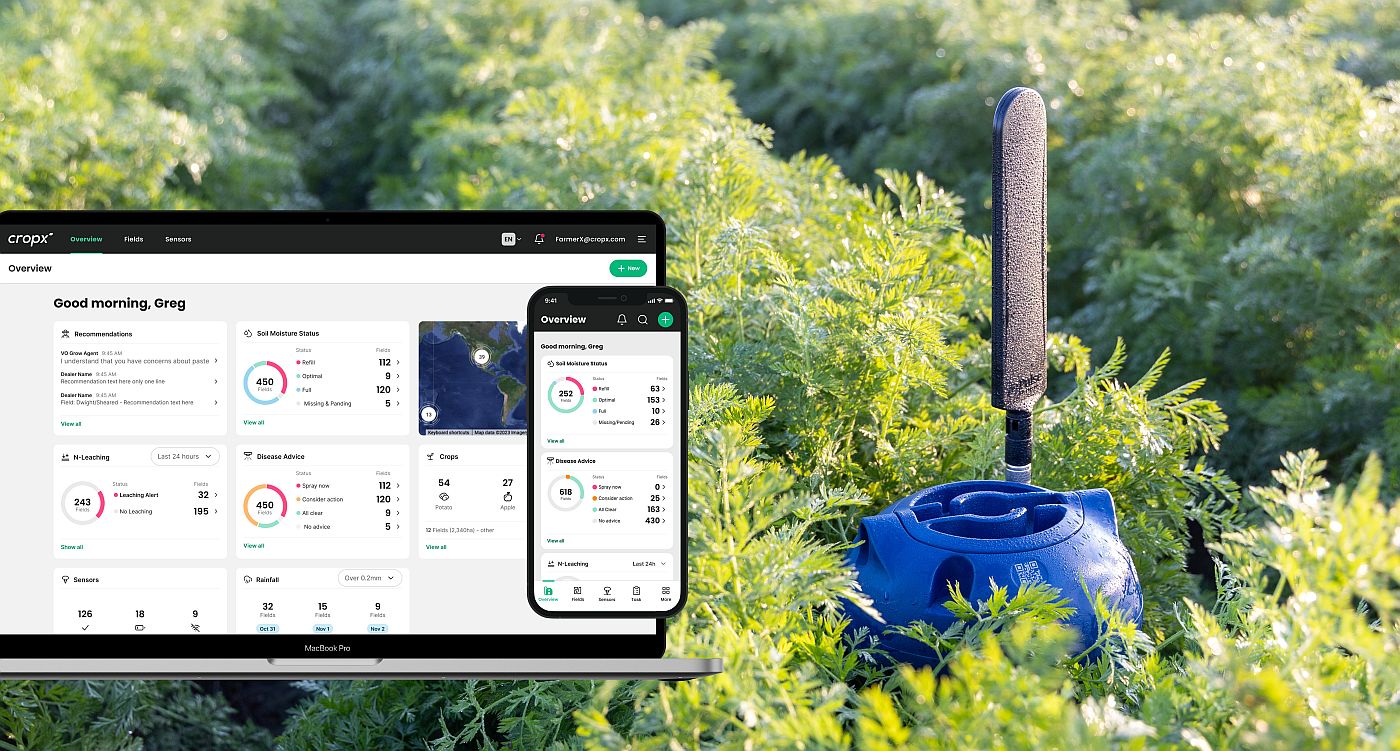
According to chief revenue officer John Gates: “We’re a little bit different. CropX is an ecosystem of measurement devices, software, and analytics. Some of our customers only want the software, but we strongly believe in offering that data collection layer [from soil sensors and other pieces of hardware from weather stations to telemetry, evapotranspiration measurement, and nitrogen-measurement tools], and we think we found areas where we really add a lot of customer value.
“But we also play well with other platforms. Data interoperability is extremely important both within our business as we acquire companies, but also data sharing and interoperability with all the major [digital ag] platforms. So we’re a platform partner of [Bayer’s digital ag platform] Climate FieldView and we have a two-way data integration with [cloud-based farm management system] John Deere Operations Center and several OEMs in the water management space, for example.”
As such, integrating tech from companies it acquires into CropX’s core platform is mission critical, says Gates: “It’s not part of our strategy to maintain multiple separate software systems and apps. We want interoperability of the data for any given customer as I think one historical challenge in the industry is that there have been too many data silos.
“In the field, everything affects everything else. The soil affects the crops, the weather affects the crops, nutrients and water interact… so you have to break down data silos if you really want to add value to the end user.”
‘We are looking to become that one-stop-shop’
As a result, CropX has now moved well beyond precision irrigation into areas including nutrient management, disease management, variable-rate scripting (creating digital prescriptions that tell farmers to apply different amounts of an input across a field), yield analytics, machine data, recordkeeping/crop recording, and sustainability compliance reporting, says Tzach.
“We are looking to become that one-stop-shop, to have everything you need for agronomy, farm management, whether it’s hardware or software, all kind of in one place.”
According to Gates: “We do see a lot of customers appreciating that they can reduce just the sheer number of digital vendors; we see that sense of relief quite frequently, because it adds a lot of business friction, all those data interoperability challenges, multiple points of contact, billing, vendors and logins, applications to download. In our experience, people love simplifying in this area.”
The latest acquisition—of Israel-based Acclym in Sept 2025—takes CropX into new territory with a platform aggregating data on on-farm practices for use in sustainability reporting, traceability programs and Scope 3 emissions tracking for large CPGs such as Nestlé, General Mills, McCain and AB InBev. “What we hear again and again is that companies want to know more about what’s happening on individual supplier fields,” says Gates.
“Sometimes it’s for carbon or water commitments, sometimes it’s about increasing yields or total supply volume—but no matter where they are on that journey, bringing all that data together across very different regions and risk profiles has historically been a big challenge.”
Barriers to adoption
Commercially, CropX is positioned as an enterprise-first platform in that most customers are agribusinesses (dealers, ag retailers, processors/off takers, agronomic service providers), although it does some direct-to-farmer selling in certain regions such as California, says Tzach.
Right now, there’s no single global rival offering, he claims. Instead, CropX more often faces regional incumbents with subsets of functionality.
The bigger hurdle is adoption: many prospects “haven’t used these kinds of tools before or tried early [half-baked] solutions years ago” and became wary.
More M&A to come: ‘We’ll take bigger bites’
Looking ahead, CropX anticipates further acquisitions—likely “bigger bites” over time—with interest both in adding capabilities (Tzach mentions controllers as a logical next step, including irrigation and other inputs) and in expanding into Latin America.
On funding, Tzach notes that CropX is extending its Series C, mainly to fund additional acquisitions rather than day-to-day operations as the business is “very close to profitability.”
Looking at the broader agtech industry, “You see more and more companies in distress,” says Tzach. “But most of the companies we deal with are successful, and companies come to us. CropX has developed a strong brand in M&A because we’re strategic buyers; we’re the consolidator of choice.
“And because of that, we’re approached by investment bankers, by founders, by VCs, because they know that joining CropX is a good solution.”
‘We have the perspective of a venture capital firm’
Over the last three years, claims Tzach, CropX has spoken to more than 200 companies in the space [about potential M&A].
“At this point, we have the perspective of a venture capital firm, so we do see more and more deals landing on our table. But we remain very picky and only look at companies that align with our strategy and where we feel there’s a strong synergy.”
Asked about the size of future acquisition targets, he says, “One thing that we’re seeing is the companies that we acquire over the years are also becoming larger in terms of revenues, so we’re taking bigger bites.”
As to how AI fits into the acquisition strategy, it’s a tool that most companies are now integrating into their businesses, rather than an end in itself, says Tzach, noting that CropX sees potential in computer vision for scouting and diagnostics plus other data-driven features such as virtual sensors and improving irrigation algorithms.
It is also using AI to turn agronomic algorithm outputs into simple natural-language recommendations for customers via text message.
But he adds: “We don’t let the AI do agronomic data processing in an unsupervised way, so we have agronomic algorithms prior to that that we fine tune to ensure they’re in line with our best science.”
Successful M&A: ‘You need to continue working on culture’
Looking back, CropX made mistakes during its rush to acquire so many companies in such a short space of time, says Tzach, but has learned its lesson.
“Some mistakes we made early on were that we started integrating too quickly, and we didn’t hold on to certain employees.
“Another thing we’ve learned is that PMI never ends; it’s not like after 18 months Dutch people become Israeli or vice versa,” says Tzach, who is based in Israel but notes that CropX has offices around the world.
“You need to continue working on culture as you become a global company because you’re dealing with people, and that always requires attention.”
CropX acquisitions:
👉 CropMetrics (US) – Jan 2020 – Precision irrigation company, which added 500,000+ acres of in-soil farm data and irrigation expertise to CropX’s platform.
👉 Regen (New Zealand) – Sept 2020 – Cloud-based effluent and irrigation decision support tools.
👉 Dacom Farm Intelligence (Netherlands) – Aug 2021 – Precision ag company with advanced advisory tools and a large customer base in Europe.
👉 Tule Technologies (US) – Jan 2023 – Precision irrigation startup with above-canopy evapotranspiration measurement technology.
👉 Green Brain (Australia) – Dec 2023 – Digital agronomy and irrigation management solutions provider.
👉 EnGeniousAg (US) – Sept 2024 – Nitrogen sensing technology company expanding CropX’s capabilities in nutrient management and precision fertilizer use.
👉 Acclym (Israel) – Sept 2025 – Ag intelligence company with tools to help F&B brands manage sustainability goals and ESG reporting.