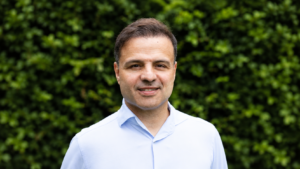

After two years focusing on managing its existing portfolio, Cargill Ventures is gearing up for renewed activity. The corporate venture arm has recently made two as-yet-unannounced investments—one in a global fund and another in the next-gen food and feed space—and expects dealmaking to pick up as startups work through the painful valuation resets of the past few years.
For head of corporate ventures Erin VanLanduit, the opportunity lies in the increasingly stark gap between early-stage startups that can still attract funding and later-stage companies with proven revenues.
Stranded in between are businesses attempting to cross the “second valley of death” from pilot to commercial scale—where capital alone may not be enough. This, she argues, is where corporates can bring technical expertise, infrastructure, customers and the ability to help turn promising technology into a viable business.
Established in 2020, Cargill Ventures has made around 20 investments and oversees a portfolio of just under 30 companies from microbiome specialists Infinant Health and AnimalBiome, alt-cocoa maker Voyage Foods, and digital commodity trading platform Grao Direto, to grain trading platform Bushel, ag software platform Regrow Ag, drone inspection co Flyability, cultivated meat companies UPSIDE Foods, Wildtype and Aleph Farms, insect ag co Innovafeed, mycoprotein maker ENOUGH Food, digital food fingerprint co ProfilePrint, silk protein co AMSilk, and Andes, a firm making microbial seed coatings that remove CO₂ from the atmosphere.
It has also invested in the Health for Life Capital II fund managed by Seventure Partners and a fund managed by Omnivore, a VC firm investing in agrifoodtech startups in India.
AgFunderNews (AFN) caught up with VanLanduit (EV) to discuss what corporates can bring to the agrifoodtech funding ecosystem and where Cargill is preparing to place its next bets.
AFN: Have we reached the bottom of the market for agrifoodtech investing?
EV: There’s been kind a years-long process of putting off revaluations. I’ve called the ‘never ending bridge financing convertible note’ for the last couple of years.
But I do feel like the majority of companies that were tied to a valuation from 2021, 2022, have had to do a priced [down] round and do some of that painful activity that’s related to recapping and so forth, so I think a lot of that is now behind us.
When it comes to [agrifoodtech] investing, I see a bifurcation. There’s still a huge ideas pipeline and a lot of active investing in all these early-stage companies. There’s also money going into later stage companies that have market traction, proof of concept, and viable long term revenue streams.
But [for companies in the valley of death in between] I do think that creates a unique opportunity for corporate partners and investors like us because it’s not just about capital; it’s about the capability, the know-how, you know, the ability to scale these technologies.
AFN: What’s your remit?
EV: We wouldn’t make an investment that doesn’t have some strategic value or impact on our businesses. That said, probably 80% of our portfolio today wouldn’t be companies that we would ultimately acquire. It’s more about partnership access and accessing technologies and capabilities that we can’t or won’t do ourselves.
We target growth stage companies, Series A and B. We don’t want to get to a company when they’re so early that we would be overwhelming in the type of partnership that we want to have, but also if they are too late stage, there’s not as much value we can add or as much we can bring to the table.
Given the funding environment today in VC, especially in food and ag, we’re seeing this second valley of death between pilot and market delivery scale, and there is a need for capital to fund these new to the world capabilities and assets at a scale that can actually serve the market.
We have done about 20 investments since 2020. We have a handful of legacy investments, so the portfolio is just under 30 now.
Most are direct, but we have a handful of indirect investments in funds in geographies or spaces where we want to expand our reach and see more deal flow and have a pulse on the market.
AFN: Do you have a fixed amount of money to work with or a rough number of investments you aim to make per year?
EV: We don’t put a target on how many investments or how much capital we want to deploy, because we found that incentivizes the wrong kind of behavior.
2021 and 2022 were high investment years because it was a very busy, frothy, market, whereas in the last year or two, we’ve been more focused on managing the portfolio that we have, driving partnerships internally, and delivering value strategically.
But we’re getting to a really interesting and exciting place where I think you’re going to see activity start to pick up again.
AFN: Have you made any investments over the past year?
EV: We have another indirect investment that hasn’t been announced yet in the global fund space that helps expand our geographic footprint and our view globally on tech. We also just made another investment that hasn’t been publicly announced yet in the next gen food and feed space.
AFN: Some corporates are known for pilots that go nowhere and slow decision making processes…
EV: Startups are always going to be wary of corporates because of how large and complex we are. But we try to help make sure things are followed through at an acceptable speed and make sure there’s alignment up front so we’re clear about what the expectation and success criteria are.
But the business sponsor really matters in this process. We want to make sure that when we’re looking at doing a pilot, whoever we partner with on the business side [within Cargill] has the conviction that this is going to add value and is going to be that internal champion.
We start with the end in mind, conversations with commercial partners are: What’s the desired outcome? What do you want to get from this? What do we hope to accomplish?
AFN: How quickly can you move on a potential investment?
EV: It’s quite a streamlined process for an organization the size of Cargill. We partner really closely with the commercial team or the function that we’re bringing that investment forward with. So they own the strategic rationale part of the investment proposal, and then my team does all the workings of the investment and the structure and the governance.
Our governing body is our ventures board, which is made up of high-level executives with expertise in technology, R&D, corporate development and IP. From start to finish, in an ideal world, we can do that in as little as 10 to 12 weeks.
AFN: What do you bring to the table vs a straight VC investor?
EV: We have deep expertise in some technical areas, specifically where it comes to scaling technology and businesses and operating on a global scale. VCs have good networks, but generally they don’t have the expertise and depth of knowledge, which is a key part of the value proposition we bring as an investor.
Another way that we differ from financial VCs is in how we think about delivering value. So while financial returns are definitely part of the equation for us, we talk about total value creation, which is cash on cash return on investment, but also the strategic value returns that we get.
Are we generating incremental revenue in an area where we didn’t have a business before? Are we able to get more business with a customer because we have a new capability?
AFN: Have big food companies struggled to come up with successful innovation models?
EV: What is going to work for one isn’t going to work for another. It depends on your business, your capital availability, the skill of your employees, and the risk appetite of the organization.
This is the third organization where I’ve worked in corporate ventures, and each of the teams was structured very differently and had different mandates, so it’s not a one size fits all.
But the common challenge is perhaps disconnection or not getting alignment all the way from the need state that a customer or consumer has all the way back upstream through technical expertise, manufacturing and operations, and then the source of the technology; it all has to string together.
It’s about thinking about what that whole path needs to look like to deliver value.
AFN: Do you have more latitude as you’re not a public company?
EV: A bit. Our shareholders are committed to private ownership, and about 80% of operating cash flow is invested back into Cargill and our community. So we have the ability to have sustained investment in areas where we want to grow long term.
AFN: How has your investment focus evolved over the past five years?
EV: It’s been quite the ride. Our investment verticals haven’t changed, but how we look for opportunity and growth within those verticals has shifted in accordance with how the market has changed and customer and consumer demands have shifted.
So our focus areas are next-generation food and feed, better health for humans and animals, a sustainable and regenerative future, smart midstream and digital platforms, and the farm of tomorrow.
But then under that, we’re prioritizing technology enablers to help us do things more efficiently, more safely. So things such as automated plant operations, smart supply chain.
AFN: Where does AI come in?
EV: We think of AI as a horizontal that cuts across every vertical, so it’s part of our evaluation process. So for every company that we look at, have an investment in, or partner with, we ask, what does it deliver, how is it going to keep differentiated, or are they doing something that can be leapfrogged easily because someone else is leveraging AI?
There’s a lot of testing, learning, and piloting with AI at the moment. But one of the amazing things about Cargill is that because we are such a large global business, we have a huge amount of market information and data and using AI to help make sense of it is definitely something that we’re working on. But AI has really changed the curve on innovation. Things that used to take months, even years can now take hours or even minutes.
That said, while there are a lot of ways that AI can be leveraged to shorten timelines for things like ingredient discovery and formulation or process modeling, you still have to bring that into the real world, so you still need capabilities for piloting and the people that know how to translate that test case in the ether into something that’s delivering a real product with real value.
We’re also interested in technologies that help monitor the health of animals.
AFN: In precision fermentation, are you focused on enabling tech or portfolio expansion?
EV: Both. We’re looking at enabling technologies for supply chain and manufacturing to make those processes more efficient and less wasteful. But we’re also asking what our customers and consumers are looking for now that we don’t have in the portfolio.
AFN: Can you point to any investments that have delivered meaningful strategic value?
EV: One of our investments is in [a drone inspection startup called] Flyability. It took some time convincing our venture board that this was an opportunity we should really lean into because its technology was actually created for chemical manufacturing and mining operations.
However, partners on our remote operating systems team said we think we can use this for site inspections that are dangerous for people to do. This is great for Cargill but has also really pushed Flyability into the food and ag sector as a provider and created a meaningful opportunity to help that company grow.
Another company we invested in is [alt cocoa and coffee maker] Voyage Foods. We’re the exclusive global b2b distributor for their cocoa alternative. Voyage has the technology capability and we have the customer relationships, scale, sourcing, and the ability to turn that into applications our customers are asking for.
Another example is Infinant Health (formerly Evolve BioSystems), a microbiome company we invested in just as the venture board was getting established [in 2021]. It has a [microbial] strain that specifically addresses gut health for infants.
Originally we were very interested in that for early life nutrition for consumer products, but now we also see an opportunity in pharma for pre-term infant gut health that is really interesting, but has to go through the [pharma] regulatory process.
While pharma isn’t immediately relevant to us from a strategic perspective, we really believe in the technology, so we’re continuing to support and partner with that company.
AFN: You’ve invested in cultivated meat, insect ag, mycoprotein and gas fermentation. Do you have any regrets?
EV: We continue to take what we call an ‘all of the above’ approach to protein, which is a big part of our business today, and there’s increasing interest in more diverse sources. But like anything else, some things are going to be successful, some things ultimately won’t.
You have to try some different things, otherwise your business is never going to grow, but there have definitely been some learnings around how we structure things. Do we invest, partner, set up a joint venture. It’s about where can we add the most value?
We haven’t written off any space. The trick is in the timing. For us, it’s all about keeping optionality and having a broad portfolio of protein offerings. With cultivated meat, we’re not at the moment leaning into that, but it is part of the portfolio.