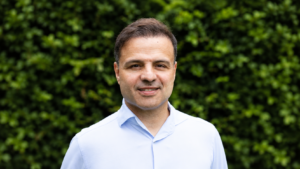
Backing African agrifood startups based on their impact alone is not sustainable, according to Sherief Kesseba, managing partner at Climate Resilient Africa Fund (CRAF).
With Africa migrating away from grants and donations, its agrifood ecosystem is evolving fast and has all the structural ingredients for outsized growth. To attract financing, startups need to be venture-investable and commercially viable, he says.
Currently, less than 5% of global VC capital flows to Africa. While investments into the continent’s agrifood ecosystem are taking root, barriers like perceived high risk, a limited pool of investible projects, and policy battles continue to dictate the slower pace of investment.
Even so, many VCs see exponential opportunities in Africa, a continent grappling with an annual agricultural sector financing gap ranging from $75 billion to over $100 billion.
CRAF backs startups early-stage startups working on food systems, climate solutions, and the nature economy. In a recent interview with AgFunderNews, Kesseba explained why, and unpacked these new emerging dynamics in Africa’s agrifood landscape.
AgFunderNews (AFN): From a VC perspective, how would you describe Africa’s agrifood ecosystem in 2025?
Sherief Kesseba (SK): The past year was difficult in terms of funding for startups. Capital allocation remained weak with flows stemming out of development finance institutions (DFIs), the only ones that have managed to de-risk the geography. For the ecosystem to develop, different capital pools and specifically commercial money needs to come into the space. This will enable DFIs to play the critical role of concessional capital.
The ecosystem is starting to shape up. In the past, Africa tried to emulate what happened in the Global North, a trend shaped by generalist funds that first entered this market. Now we are seeing more sector-specific funds emerge and bringing a different conversation based on understanding what the farmer really needs. One big understanding is that unit economics actually work, and that Africa does not need to follow the Silicon Valley growth trajectory.

AFN: What were some highlights for CRAF in 2025?
SK: During the past year we participated in a few deals. We took a ticket in Winich Farms, a Nigerian agritech company that provides financial services to both smallholder farmers and smallholder offtakers. That inclusion into the formal economy and access to credit has had massive [impact] on the revenue stream of the users and hence it is growing exponentially.
We also backed Egyptian firm Sea Gardener, which has built an innovative aquarium system that allows it to sell shellfish across Egypt and export into Europe and North America. Egypt has a massive coastline but does not export shellfish. Morocco and Tunisia, with much smaller coastlines, export about a $1 billion worth of shellfish. This means the opportunity is quite massive for Egypt. While the ticket sizes—at $100,000 and $200,000—are small, we are excited about both companies.
AFN: What are some of the notable technological innovations and trends that occurred in 2025 that are encouraging for VCs?
SK: One major trend was a regulation that came into effect in Europe and which is forcing supply chain models to look at how they supply based on standards around traceability, deforestation and the matrix of impacts.
The regulation has seen the emergence of startups like Vais is Egypt. The firm uses satellite technology to provide actionable data for farmers to make better decisions. Reality is that going forward, it is not just about technology but also the ability to meet the required specifications for supply chain management.

AFN: You harbor a strong view that massive inefficiencies in Africa offer venture-scale opportunities for VCs. What are your expectations for 2026?
SK: Focus will be on building small clusters of smallholder farmers with an aim of increasing their revenues and providing them with access to credit and access to markets. VCs will also back supply chain innovations that are resolving inefficiencies across the chain, be it logistics, cold systems, [and other areas]. Others will be on the lookout for climate-smart solutions that provide better ways to farm in a more sustainable manner and want to achieve scale. For VCs, the massive inefficiencies in Africa’s agrifood systems should not be a threat. Rather, they offer significant opportunities.
AFN: What are the fundamentals you expect to influence VCs decisions in backing startups in Africa?
SK: The topmost factor that VCs look out for is the founders. VCs want to deal with founders who have a clear vision and are pushing models that make sense. In essence, it is about startups that demonstrate zeal for capital efficiency as opposed to expecting capital abundance. Besides that, VCs will of course be looking for impactful and sustainable models, those that are able to solve unit economics before they scale.
AFN: Agrifood startup mortality in Africa remains high. Is this alarming for VCs?
SK: The high mortality rate is because most startups do not focus on units of economies. In Africa we have challenges across the whole supply chain. We see startups use technology to unlock something but then lose track of margins because the first mile and the last mile are so expensive. This shows that the faster they grow, the faster they lose margins.
Startups need to go back to basics in terms of building sustainable models that are not just based on showing growth for the next round of fundraising but actually showing sustainable growth that has strong unit economics.