Much of today’s available agricultural data tells farmers only what is happening on their fields; which crops are growing, whether plants are healthy, where pests are beginning to appear. While that answer has value, it only deals with the most surface-level information. Deeper insights, around land-use efficiency, proving sustainability practices, and tracing a crop through the supply chain, remain out of reach for most farmers, buried in paperwork, scattered across disconnected systems, or simply invisible.
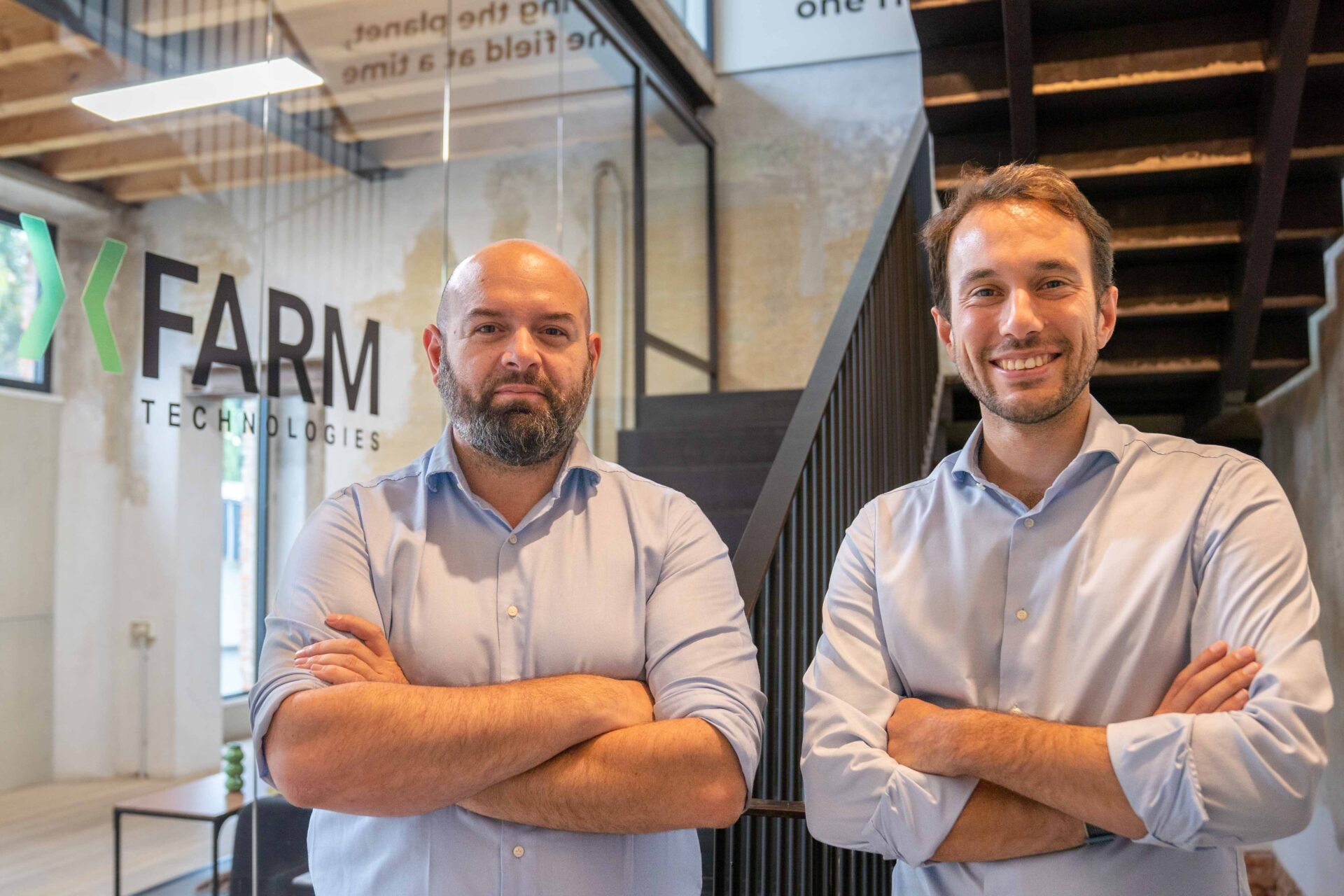
xFarm Technologies has spent the past several years trying to change that. Founded by Matteo Vanotti and Matteo Cunial, both with roots in farming, the company built a platform to collect, organize, and put to work every layer of data a modern agricultural operation generates.
Today, the platform serves more than 600,000 farmers across Europe, Brazil, and India, managing 24 million hectares of farmland.
The company’s latest move, the acquisition of Brazil-based Sibium Analytics, adds not only another 8 million hectares to its footprint but also a new set of capabilities xFarm believes will become central to how global agriculture gets measured, financed, and traded.
Building the data layer of global agriculture
Vanotti says the company’s goal is to build “the data layer of global agriculture.” In practice, this means the ability to connect primary field data with satellite remote sensing, supply chain tracking, and compliance reporting. The system delivers all of this information through a single interface that a farmer, an agronomist, a food company, or a biofuel auditor can actually use.
That multi-layer approach has become the company’s defining characteristic. At the field level, xFarm collects data through IoT sensors, machinery integrations, and direct farmer input. A second layer draws in remote sensing from satellites; crop mapping, biomass analysis, yield estimation, that enriches what ground-level data alone cannot tell. A third layer turns all of that into actionable intelligence: crop-specific advice, irrigation scheduling, pest alerts, and real-time compliance monitoring across regulatory and supply-chain frameworks simultaneously.
The interface itself, Vanotti stresses, must be a straightforward experience for any user. The company recently launched an AI agent that lets farmers interact with the platform in plain language and via the app or directly through WhatsApp. Ask the agent which field to irrigate and it can respond: put 10 millimeters of water on that field at eight o’clock tomorrow. No dashboards to navigate, no tables to interpret.
What Sibium brings
xFarm has completed six acquisitions over the past four years, each adding a new geography, a new crop segment, or a new technical capability. The Sibium deal addresses all three areas at once.
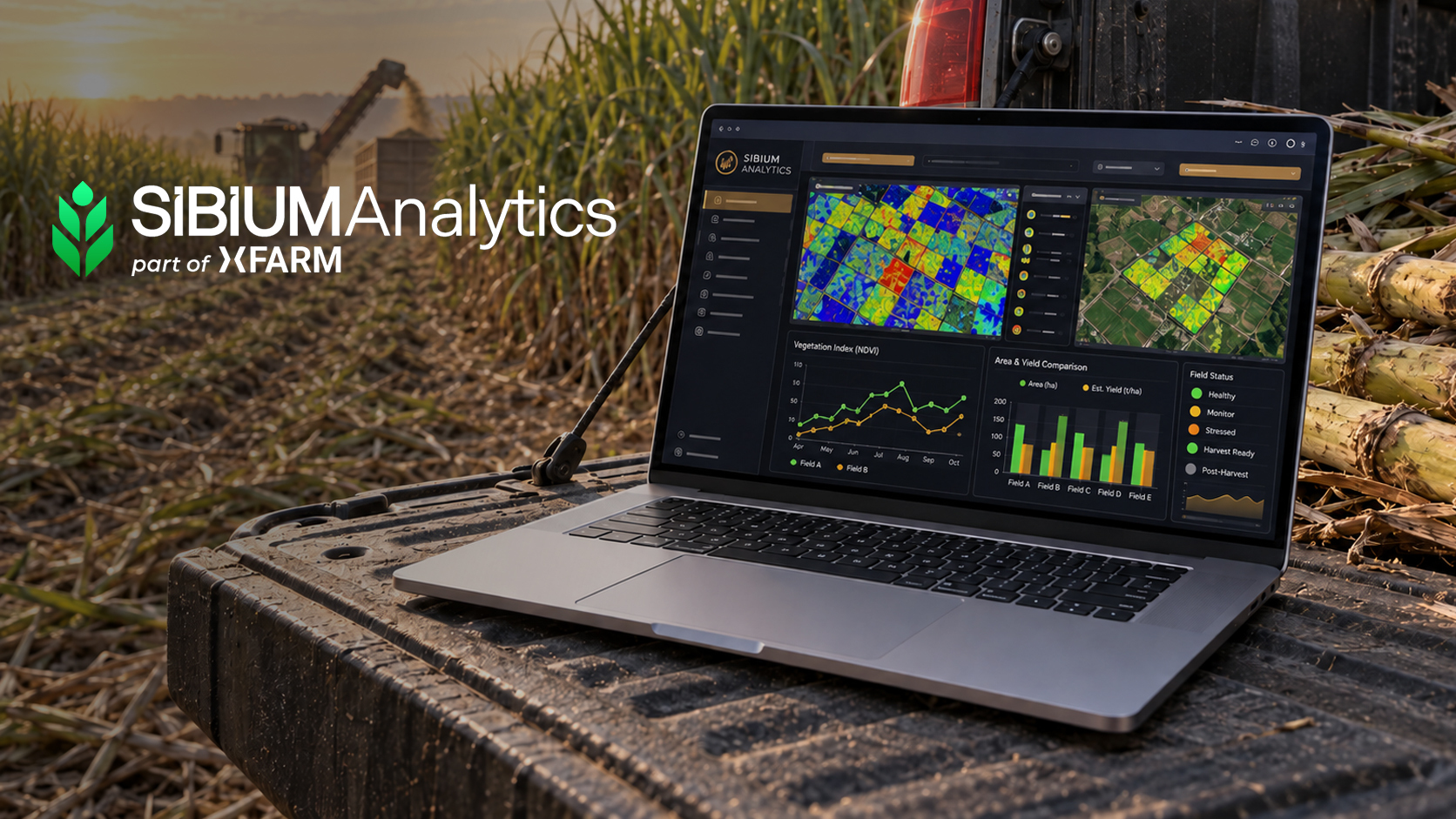
Sibium Analytics is one of Brazil’s leading agtech companies in the sugarcane sector, working with nine of the country’s largest producers and monitoring more than 8 million hectares annually.
That scale matters because Brazil’s sugarcane industry is immense: the country produces roughly half of the world’s sugarcane, exports to 145 countries, and is the world’s largest producer of sugarcane ethanol. For xFarm, which was already number one in Brazilian cotton and well-established in corn, sugar beet, and coffee, the acquisition completes its major crop coverage in what has become its second-largest market.
But the strategic logic goes beyond filling a gap on a crop map. Sibium has built three products (SIGMA for Crop Monitoring, AMBIUM for ESG Audits, and DATA VIEW for analytics) that xFarm intends to deploy to its existing client base across Brazil and Europe.
Together, these three products enhance xFarm’s existing supply chain intelligence solutions. With Sibium integrated, the platform can follow a crop from the moment it is planted, through harvest, processing, and certification, to the point where a buyer needs to verify its provenance and environmental profile. That end-to-end traceability is precisely what regulators, food companies, and increasingly, financial institutions are beginning to require.
The energy angle
One aspect of the Sibium deal that sets it apart from a conventional agtech acquisition is the biofuels exposure it creates. Brazil’s sugarcane ethanol industry is not a niche market: roughly 80 percent of ethanol produced in the country comes from sugarcane, which also generates bioelectricity for the national grid. New regulations expected in 2027 will significantly increase documentation requirements for biofuel producers, creating demand for the kind of audit-ready data trail that Sibium’s platforms are built to generate.
“If you want to sell biofuel, you need more and more documentation and data,” Vanotti says. “That is a business that is increasing.”
xFarm intends to take those capabilities into other sugarcane markets; India, Thailand, and others, and to expand the bioenergy offering into adjacent areas. In Europe, the company is watching biogas and biomethane closely as the regulatory environment tightens around fuel sustainability, while it already works with key players in the Agrivoltaic and Solar panel business.
Consolidation, at scale
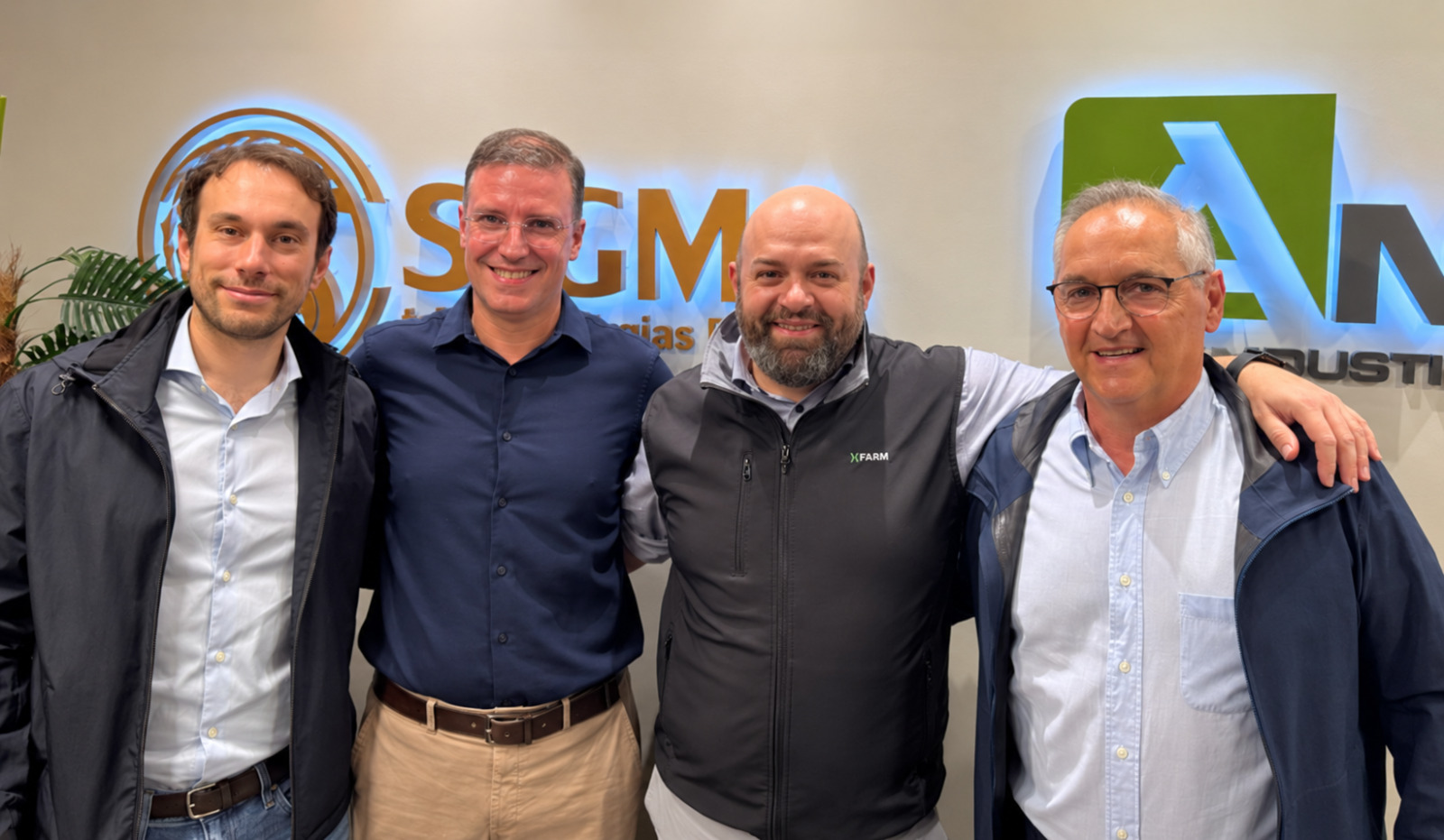
The Sibium deal is the second Brazil acquisition xFarm has completed in two years, and Vanotti says this pace will continue, both in existing geographies and, eventually, further afield.
Agriculture’s data market remains highly fragmented: local champions dominate individual countries, crop segments, and supply chain niches, and the regulatory complexity of each market means there is no simple global rollout. Acquisitions, when coupled with strong organic growth, accelerate this global expansion.
With more than 24 million hectares now under management, the company believes it has reached the scale at which its data advantage becomes self-reinforcing. More hectares mean richer training data for its agronomic models, more precise recommendations for its farmers, and a stronger value proposition for food companies and financial institutions looking for a single window into global agricultural supply chains. The addition of BlackRock as an institutional backer for this operation suggests that the consolidation strategy is drawing interest from well beyond the sector’s usual investor base.
For a platform that started because two farmers could not keep up with their own paperwork, that may be the most striking signal of how far the data layer has come.