Ammonia and manure are two of the most effective ways to give corn the nitrogen it needs, but they come with a cost to the soil, says Jeff Divan, VP of agronomy at US-based Sound Agriculture.
Ammonia makes the soil more acidic and kills off some helpful microbes where it’s applied. Manure can hold its nitrogen in a form the plant can’t use until after the corn needs it most.
“High ammonium creates a harsh environment for soil biology — it reduces microbial diversity, which leads to inconsistent root development and lower yields,” notes Divan.
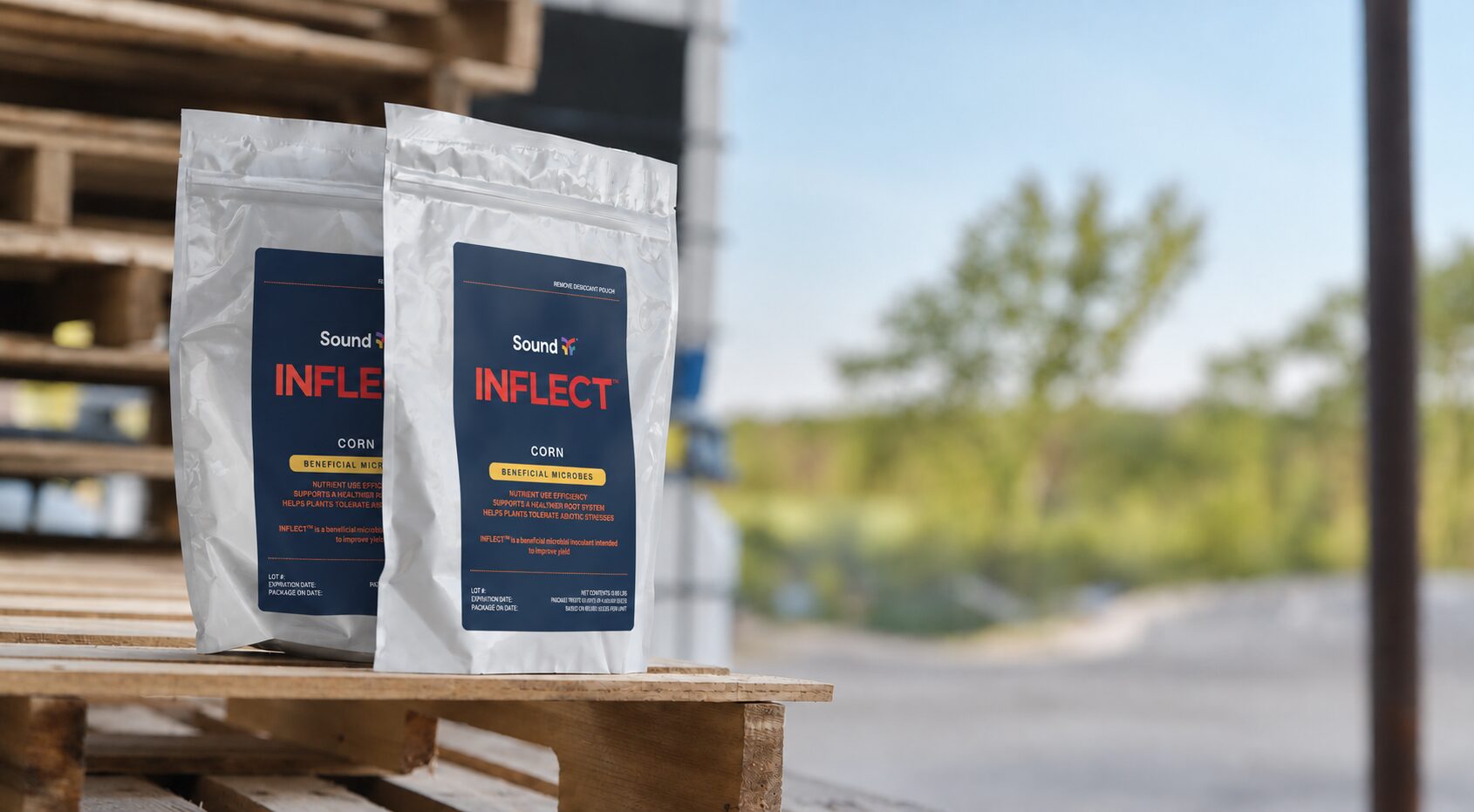
To help farms combat this, Sound Agriculture just released its latest product, INFLECT, a seed coating made of “helpful” microbes and designed specifically for corn fields fertilized with anhydrous ammonia or heavy amounts of manure.
The product launches at a time when most US corn growers are “more or equally concerned” about their farm costs compared to one year ago, and as many look for ways to reduce dependence on synthetic fertilizers. More and more, farms are turning to nature—or as Divan puts it, “making something from what’s already there” in the soil.
How it works
INFLECT is a planter box seed treatment applied as a powder to seeds at planting time.
Once seeds are in the ground, two species of bacteria (Bacillus simplex and Bacillus subtilis) and one fungus (Coniochaeta nivea) go to work, says Divan. The company selected these strains based on their ability to tolerate the high-salt, high-stress conditions high ammonium fertility creates.
When an anhydrous substance is present in the soil, it often causes an imbalance of pH in a plant’s root zone, making nutrients less available to the plant.
The two strains of bacteria in INFLECT create a buffer between roots and the anhydrous substance, which stabilizes pH and promotes root growth. The fungal strain, meanwhile, breaks down manure and other complex compounds, so that organic nitrogen and other nutrients can reach the plant.
Divan says the product has been several years in development, including a year’s worth of field trials across the corn belt in the Midwestern US. He did not disclose total acreage of those trials, but noted they are “commercial scale” and taking place at 12 different sites across lllinois, Kansas, and Missouri.
The company says it has so far raised corn yields by about six bushels per acre on average and improved yield at 92% of the sites.
For now, corn is Sound Agriculture’s main focus for INFLECT. Divan says the company is “exploring other crops” for potential application in the future.
Building fertility around biology
INFLECT is Sound Agriculture’s third product, joining its signaling chemistry SOURCE, which helps crops get more out of the nitrogen and phosphorus in the soil, and BLUEPRINT, an arbuscular mycorrhizal fungi (AMF) solution that enhances nutrient and water uptake.
Divan says there may be an opportunity in future to pair SOURCE’s signaling technology with INFLECT to also increase phosphorus efficiency in corn. This is similar to the way SOURCE “supercharges” BLUEPRINT currently, he says.
“We’re combining our products in ways to support biology’s ability to create organic acids and enzymes, and pull phosphorus from the soil and reduce synthetic dependency.”
Equally important is helping growers understand that they can build their overall fertility plans around these beneficial microbes, versus simply adding biology on top of existing plans.
“It’s important to not just add [biologicals] on top of existing programs but create space for them,” says Divan. “Let biology and products like [those from Sound Agriculture] be your first 25 pounds of fertility. When folks take that approach and peel out expensive applications, we see really good results.
“Far and away, as time goes on, our best wins are when somebody reduces or replaces a portion of dry fertilizer with an active soil microbiome.”