
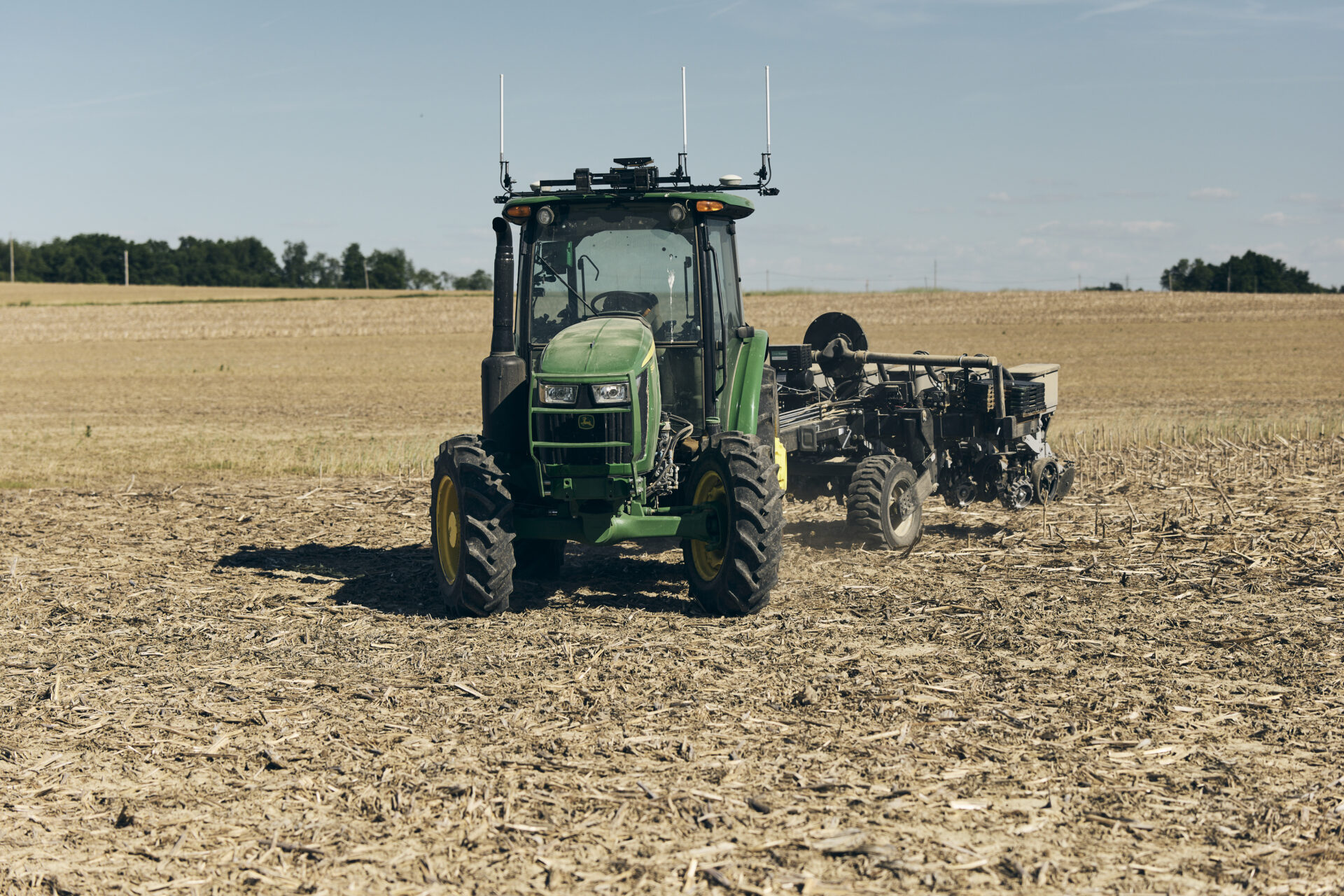
Sabanto, best known for its autonomy retrofit system for agriculture, has raised an oversubscribed Series B round to bring “practical autonomy to more farms,” according to founder and CEO Craig Rupp.
“We believe autonomy should reduce capital investment, not increase it,” he tells AgFunderNews. “Instead of investing in more horsepower, farmers can invest in more productive hours by deploying smaller, lower-cost autonomous tractors.”
Leaps by Bayer led the round with participation from Sustainable Forward Capital, InnoVenture Iowa, Fulcrum Global Capital, DCVC, and Yara. Financial terms of the deal are undisclosed at this time.
Lowering the cost of farm autonomy
Sabanto retrofits existing tractors with its Retrofit Autonomy Kit system made up of advanced cameras, obstacle detection sensors, global navigation satellite systems (GNSS), and robotics.
These elements plus accompanying software enable tractors to operate autonomously for seeding, tilling, aeration, and other field tasks. Currently, Sabanto’s system works with John Deere’s 5E, 5M, and 6E series tractors, as well as Kubota’s M5 series.
Rupp, who has worked at Deere and also sold a company to The Climate Corporation in 2014, says that when it comes to automating tasks, retrofitting existing machinery is far more cost effective for growers than expecting them to purchase an entirely new product.
Sabanto, he says, is “enabling farmers to leverage existing equipment or purchase lower-cost tractors rather than investing in increasingly expensive high-horsepower machines. This retrofit approach lowers the cost of adopting autonomy while delivering the productivity benefits of around-the-clock operation.”
The system has precision agriculture applications, too, something recently highlighted in news of Sabanto’s partnership with Verdant Robotics. The latter’s SharpShooter precision application system can now run behind a Sabanto-equipped autonomous tractor, potentially saving growers on both labor and input costs. [Disclosure: AgFunderNews parent company AgFunder is an investor in Verdant Robotics.]
‘They understand the farmers’
Sabanto already has deployments around the United States and in Australia, which suggests the company already has a firm grasp on the use case, according to Paimun Amini, VP of Agriculture Venture Investments at Leaps By Bayer.
“They understand farmers are scaling up the use of this,” he tells AgFunderNews.
Amini echos Rupp in pointing out the cost advantage of autonomy retrofits versus building new machinery that might cost half-a-million dollars at minimum for a single machine.
“When we [Leaps By Bayer] talked to a bunch of farmers and customers out there, the biggest issue they were facing was around liquidity—the cash they have on-hand,” says Amini.
“The ability to offer a solution that can make their farms autonomous while minimizing labor costs and giving them an alternative to major capital purchases was something we thought that we could solve by supporting Sabanto in their journey.”
He says part of Leaps By Bayer’s due diligence process involved working with farmers who didn’t use any autonomy, running numbers on those operations, and seeing that an autonomous retrofit “always inked out better than a lot of the alternative options.”
“In the world of farmers being squeezed for for cash, this provides them a way forward to solve two of the biggest issues, which are cash and labor,” he notes.
From technology to economics
Rupp highlights Quint Pottinger, a farmer from New Haven, Kentucky who gained attention for reducing his farm equipment to a single 135 horsepower tractor and a 20-foot planter equipped with Sabanto’s autonomy kit.
“By rethinking the traditional ‘bigger is better’ model, Quint reduced his equipment capital investment by approximately 70% while increasing daily planting productivity through around-the-clock autonomous operation,” notes Rupp.
He adds that Pottinger managed to plant his entire corn crop autonomously this year, and used the savings to buy cattle, “something that actually makes money and doesn’t depreciate.”
“Quint’s the talk of the town in New Haven amongst the farmers. What’s even more interesting is the local bankers took notice. The topic of conversation is changing from the technology to the economics.”
The Series B round will support a number of measures around expanding Sabanto’s customer base and further developing its autonomy kits.
Amini reiterates that in all activities, it’s about working with what farmers already have to make the biggest impact, including retrofitting fleets of tractors on a single farm.
“One of [Sabanto’s] largest customers is running 25 of these at the same time. That transformative, and then the math really works out well. You can argue that something about a retrofit kit is less sexy than than a big new wholly autonomous system, but it is the thing that focuses on the farmer economics.”