IMIO, a startup developing biologicals that break down crop residues to release nutrients that can boost crop yields and reduce fertilizer use, has raised a $12 million seed round.
The round—which takes the firm’s total funding to $16.5 million—was led by Sofinnova Partners and supported by Chipotle’s Cultivate Next venture fund, Starshot Capital, Grow Together Salinas, Earth Foundry, and Serra Ventures.
It will help the firm expand its team, ramp up production capacity and build out a new biomanufacturing and R&D facility in Chicago.
Why it matters
While biologicals do not always deliver the cost, stability, scalability and repeat performance that many farmers need, IMIO claims its approach can address some of these challenges by applying highly concentrated, naturally occurring microbes directly to crop residues, founder and CEO Charles Smith told AgFunderNews.
Rather than attempting to establish microbes in the soil, where they must compete with existing microbial populations and potentially form relationships with plants, IMIO’s flagship products, Re-Gen for Row Crops and Re-Gen for Produce, create an environment in which the microbes can get straight to work breaking down organic matter.
And by freeze-drying individual microbial strains before blending them into a powder with a 12-month+ shelf-life, IMIO claims it can deliver significantly higher levels of microbial activity than competing products, with greater consistency from batch to batch.
Nutrient recapture
Founded in 2019 in Vermont, IMIO began with a focus on recovering value from organic matter that would otherwise go to waste, said Smith, who previously worked in finance and software startups.
While results from trials designed to accelerate composting were encouraging, the economics of the industry prompted a rethink: “We realized that working with compost facilities would be very challenging as many of them actually operated at a significant loss.”
Farms, by contrast, generate vast quantities of organic matter in the form of crop residues, and spend significant sums on fertilizers to supply nutrients to the following crop, he said.
An acre of corn stover, for example, contains approximately $134 worth of nitrogen, phosphorus and potassium, according to Smith, while the nutrient value of residues from some specialty crops such as broccoli are even higher.
“Farmers have this nutrient reservoir that they will sometimes call trash, but that is ultimately something that can be a really valuable resource.”
Faster breakdown, better timing and access to nutrients
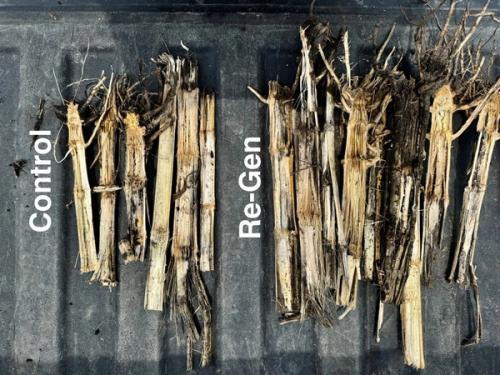
While crop residues naturally decompose over time, IMIO claims its microbes can both accelerate the process and increase nutrient availability at the point when crops need it.
Re-Gen is typically applied in the spring around planting time to help release nutrients in a timeframe that allows the next crop to utilize them.
IMIO is also addressing a growing challenge as crop breeding and management practices generate residues that are harder to break down, he said, citing the higher lignin content in modern corn varieties.
Conventional agricultural practices can also reduce populations of naturally occurring fungi in soils, potentially limiting their ability to break down crop residues without additional intervention, he claimed.
Freeze-drying
IMIO’s patent pending microbial formulations contain naturally occurring, non-GM organisms selected for their ability to break down organic matter.
The microbes are grown individually before being freeze-dried, blended in predefined ratios and shipped to growers as a powder they can mix with water when they are ready to apply them.
While conventional spray-drying uses heat to remove water, which can kill or damage some organisms, freeze-drying, or lyophilization, is a gentler process that helps preserve microbial viability, said Smith.
This is especially important for some of IMIO’s lignin-degrading fungi, which would not survive conventional heat-based drying processes.
The company is building additional production capacity in Chicago but also works with manufacturing partners on fermentation, including a facility in South Dakota equipped with lyophilizers [freeze dryers], explained Smith.
“They have lyophilizers that they run on site, and we have created restricted access control units so they can basically hit a button and run our protocol without any of the protocol details being exposed.”
Field trials: 11.9-bushel average yield increase in corn
While there are several ways to validate the performance of the microbes from testing soil nutrients to visually inspecting crop residue, “We generally orient our data towards the things that drive economic returns for farmers,” said Smith. “So that’s yield improvement, fertilizer savings, and potentially tillage savings.”
IMIO has tested Re-Gen in university and farm trials covering 10,000+ acres in the Midwest in 2024 and 2025. These delivered an average yield increase of 11.9 bushels per acre, although responses varied from 5 extra bushels to 20+ depending on residue levels and existing crop management practices.
According to Smith: “We can also save farmers tillage passes. We’ve been able to show that in the row crop world and in the produce world.”
While corn is an obvious target given the volume of residue it generates, IMIO is also making inroads into specialty crops, including broccoli, Brussels sprouts and lettuce, where Chipotle has helped put it in touch with growers.
Cover crops also represent an opportunity, said Smith, given the volume of organic material they contribute to soils.
Commercial traction and go-to-market strategy
IMIO has been generating commercial revenues on a small scale for a couple of years and now has 100 customers. It initially sold directly to farmers but is now beginning to work with distributors.
One early customer is Kirk Stueve, who farms and owns land leased to other growers across Minnesota and Wisconsin. After a couple of years of use in a high-residue, four-year corn-on-corn rotation, the treated 140-acre field exceeded its historic yield record by 36 bushels per acre, enabling Steuve to cut his nitrogen bill by $45-50 per acre without sacrificing yield.
According to Stueve: “A lot of biologicals have great marketing strategies and sales teams but struggle to deliver in reality. From what we’ve seen so far, IMIO is an outlier.”
While investors can be wary of biologicals, IMIO’s commercial traction in row crops and specialty crops helped seal the deal coupled with the consistency of its products, claimed Smith.
“What we hear from farmers and agronomists is that consistency has been the biggest challenge when it comes to wide scale adoption and trust in biologicals. People need conviction that the consistency of performance will be there and the ROI will be reliable. We can address that through our mode of action and through best-in-class microbial activity.”
Further reading:
Switch Bio partners with Bayer to advance ‘switchable’ tech for biofertilizers
Exclusive: Lilac Agriculture raises $2.3m to tackle inoculants’ ‘black box’ problem
🎥 Atmonia scales green ammonia with single-step electrochemical process

Sign up for our weekly newsletter.