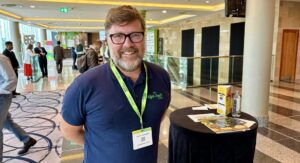
“We don’t want to repeat the debacle of GMOs,” Corteva Catalyst’s Mathias Müller said at the recent F&A Next Summit in Wageningen, the Netherlands. One way to advance the next wave of gene-edited crops, he said, is to enable small- and medium-size partners to “do a lot of the legwork.”
Müller, senior director of the agrochemical giant’s investment arm, noted that many of these SMEs are focusing on crops closer to consumers. He pointed to Pairwise, a North Carolina-based pioneer in CRISPR-based crop development and a Corteva partner, that unveiled a seedless blackberry in mid-2024. “The consumer sees the difference,” Müller said, which can contribute to “creating a pretty good, positive vibe” in the market.
In the meantime, for large incumbents like Corteva, “what we have to ask ourselves is how do we help our customers, not necessarily consumers […] to make sure farmer adoption occurs and deliver products the farmers really need?” he said.
Müller and other panelists at F&A Next described these adoption challenges as critical, with uptake on farm plots and grocery shelves being two spokes of the same wheel.
“For the moment, we do have a natural constraint and that’s simply customer acceptance,” said Florian Jupe, strategic partnerships lead for biologics at Bayer. Price, of course, is a big factor in that calculus too, he said: “Is the farmer willing to pay potentially a premium for the seed that he buys because it has a certain trait in it?”
The same can be asked of consumers. Jupe pointed out that a purple, antioxidant-rich GMO tomato, developed by the privately held California biotech Norfolk Healthy Produce, is already a hit in the U.S. “Customers are buying it, they are selling the seeds through QVC,” he said.
Regulatory considerations are another hurdle for developers, though the proposed updates to GMO and seed regulations in the European Union could give large players like Bayer more room to run. Since the German life-sciences giant acquired Monsanto in 2018, the company has been dogged by cancer claims (which Bayer denies) related to Monsanto’s Roundup weedkiller; a key part of that high-profile legal saga is now before the U.S. Supreme Court.
Dominic Hall, CEO of the UK-based seed discovery company Biographica, noted that the rhetoric among early GMO opponents revolved around resisting “big bad” seed companies. While he doesn’t foresee a new “massive tidal wave” of gene-edited crops around the corner—for regulatory and biological reasons alike—Hall speculated that democratizing the development process could help win more public support.
That’s an important goal for Herco van Liere, business development lead for the Crispr4All Alliance at Wageningen University & Research. “Gene editing will be an additional layer to the toolbox,” he predicted, but it needs to proceed gradually and at multiple levels of the industry to get there. “If it comes only from the larger ones that push the boundaries, you’ll get pushback.”
One hindrance is the limited number of European SMEs in a position to contribute, van Liere said, as those that exist aren’t always at the leading edge of crop genetics. His hope is that more collaboration across the sector can begin to change that. “Sometimes you have to move slow to go fast,” he said.