Milan-based private investment company GERBER-RAUTH has sold dairy commodities broker and trader L’Interform to Atlante, an Italian firm specializing in global food sourcing and private-label development, as it steps back from commodity dairy and doubles down on advanced food technologies. Financial terms were not disclosed.
Founded in 1968, L’Interform introduced many European dairy brands to the Italian market and more recently expanded its reach to North America, broadening its assortment to include plant-based dairy alternatives.
Bologna-based Atlante, which partnered with Migros in 2011 when the Swiss retailer took a 20% stake, said L’Interform would benefit from its broader sourcing, product development, logistics and retail-market expertise.
For GERBER-RAUTH—which has made a couple of high-profile exits in recent years, selling its stakes in plant-based CPG firms Kate Farms and Whitewave Foods to Danone—the sale marks a more fundamental strategic shift, chairman and managing director Christian Pichler tells AgFunderNews.
While the firm has roots in traditional dairy trading, its investment thesis has increasingly moved toward precision fermentation, advanced plant-based ingredients, specialty nutrition, and other technologies that could reshape the dairy ecosystem, says Pichler.
“We’re not very well known, but we have over time used our dairy know-how—we have 50 years of industry experience and networking—to go really deep into technology,” adds Pichler, who says GERBER-RAUTH began investing in the first wave of plant-based dairy alternatives before 2020, before moving into fermentation-derived ingredients with investments in firms including Perfect Day (whey proteins via fermentation), Change Foods, and New Culture (casein via fermentation).
Over time, however, the overlap between L’Interform’s core trading business and GERBER-RAUTH’s newer technology investments became less obvious, he says. “The dairy commodities trading business over time became driven by commodity cheese sales, and so, naturally, around 2024 it became kind of apparent that we just didn’t have a lot of synergies.”
‘A stronger home’ for L’Interform
The timing of the deal, which was closed last year, also reflects broader consolidation in dairy, says Pichler, pointing to vertical integration among larger dairy groups in Europe, the US and Asia, and growing pressure on independent trading businesses.
“We had a really interesting business, very resilient, but we were one of those natural pieces that either was going to be acquired anyways, or slowly we would have just lost volumes and importance,” he says, noting that L’Interform’s exposure was largely to trade between German-speaking Europe, France and Italy.
Atlante, which was “not so strong in dairy,” will bring a broader retail-facing platform, he says. “It is a more natural, stronger home for this business that can bring many more synergies.”
From commodity cheese to higher-value ingredients
For GERBER-RAUTH, the sale frees up time and capital to focus on investments in what Pichler describes as the future dairy ecosystem, although he stresses that the firm is not a conventional VC fund.
“We’re like a family office, a private investment company, but we operate like a sophisticated fund that’s investing in the future of dairy, which is not just animal dairy, but plant-based dairy and bio manufacturing for dairy.”
Unlike a traditional fund, he says, GERBER-RAUTH does not face the same pressure to deploy capital or force exits. “We actually would like to make the least [number of investments] as possible, the longest term possible with the biggest impact.”
The firm’s focus remains dairy-adjacent and includes nutraceuticals, dairy proteins and fats, and oleosomes, naturally emulsified fat droplets in plant seeds that can be used to improve texture, stability and mouthfeel, says Pichler: “It’s mostly ingredients that will end up in specialty nutrition and higher added value solutions.”
‘Cheese is now the byproduct’
Part of the rationale for moving away from commodity dairy is structural, says Pichler: Europe’s milk pool is not growing, farm succession is challenging, and milk production remains volatile because supply cannot be turned on and off like an industrial process.
Animal-based dairy won’t disappear, he says, but will be used in higher-value applications, while bio-manufactured and plant-based ingredients may end up serving the commodity markets, which might seem counterintuitive now, but long-term seems logical as cost structures evolve and scale increases.
“With bio manufacturing and plant-based sources, as we solve them and scale them, you can basically more easily match supply and demand. You can bring production closer to where the demand is and make it more storable.”
While casein is challenging to produce via precision fermentation from a technical and economic perspective, he says, the case for beta-lactoglobulin (BLG), the primary protein in whey, is rapidly becoming more compelling as whey protein prices surge.
Indeed, such is the demand for whey, which was once thrown away as a byproduct of cheesemaking, that cheese is “becoming the byproduct” of whey-making, he says.
However, highly functional casein proteins may still make sense if they can be used at lower inclusion rates or unlock better next-generation cheeses, he says. He also points to tech from firms such as Bettani Farms to functionalize storage proteins in certain plants that can deliver the functionality of casein.
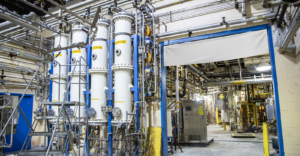
Food-grade biomanufacturing, not pharma-grade economics
As new, lower cost food-grade fermentation capacity comes online, meanwhile, the unit economics of biomanufacturing for dairy proteins and other food ingredients start to make more sense, he claims.
“The Indian CDMO companies, I think, have realized that if they put down facilities that are more suitable for food manufacturing, the economics will work, and companies with the right strain technologies and productivity will come to them.”
In Europe, meanwhile, fermentation players are increasingly willing to explore food projects using idle capacity, provided partners can invest in downstream processing, he claims. “We have seen P&Ls and models where the economics will work out and can match any whey protein plant that exists at the moment.”
But Pichler is not wedded to one technology platform, and notes that lower-value, higher-volume ingredients may be better served by advanced plant-based processing, while fermentation may be better suited to higher-value proteins and bioactives.
The death of some foodtech companies greatly exaggerated
While many foodtech startups are struggling in the current funding environment, Pichler says less capital can also force discipline. “Too much capital created a lot of exuberance and a loss of focus.”
That said, some companies that were widely written off may be better positioned after restructuring, he claims. “Some companies are presumed to be dead, and they are actually very much alive and kicking and better.”
Others that raised a lot at the peak of the cycle “will not make it or can’t make it,” however. “What you then look at is, is there anything that the company has developed in terms of IP that in the right environment with the right setup, even with much less money, can proliferate? If there’s good IP, they will be recapitalized, and might then become something different.”
GERBER-RAUTH’s focus now is to make long-term investments where it can bring industry relationships, geography-specific expertise, and dairy know-how, rather than simply provide capital, says Pichler. “We’re trying to be very focused, but we see a lot of opportunity.”
While GERBER-RAUTH can write early-stage checks below €100,000 ($116,000) it can also invest millions of euros in later-stage companies, provided it sees a way to stay relevant and help companies reach the market, he says. “We want to be long-term involved.”
As for GERBER-RAUTH’S previously flagged “future of dairy” fund, Pichler says the idea remains possible, but only if the right strategic consortium comes together. “Funds can be a double-edged sword in that once you saddle that horse, you need to go with it; you have a pressure to deploy and a pressure to push companies to exit.”

Sign up for our weekly newsletter.