
CropX has continued its buying spree with the acquisition of near-infrared spectroscopy specialist SCIO and says it is now approaching an ARR (annual recurring revenue) of $20 million and expects to achieve profitability in 2027.
The deal—CropX’s eighth in six years and its largest to date— extends its digital agronomy platform beyond the growing season into pre- and post-harvest crop quality measurement, adding a company with around 10,000 devices deployed globally across multiple crops.
CropX did not disclose the terms of the transaction or say how it was funded but says its acquisitions are typically funded through a combination of shares, cash, and debt.
According to CropX CEO Tomer Tzach, SCIO (formerly Consumer Physics) had “gone through a challenging period that ultimately led the shareholders to explore a strategic solution.”
He told AgFunderNews: “The business has since stabilized and is now profitable, and CropX was a particularly strong fit given the strategic synergies, our M&A track record, and the opportunity for SCIO’s shareholders to participate in the future upside of the combined company.
“We’re bringing in a team of 25 people, the software team, the hardware team, the data science team, the manufacturing team, the sales team. “This is our largest acquisition to date; it’s a sizeable company and they have the best customers in the industry.”
Closing the loop between in-season recommendation and post-harvest data
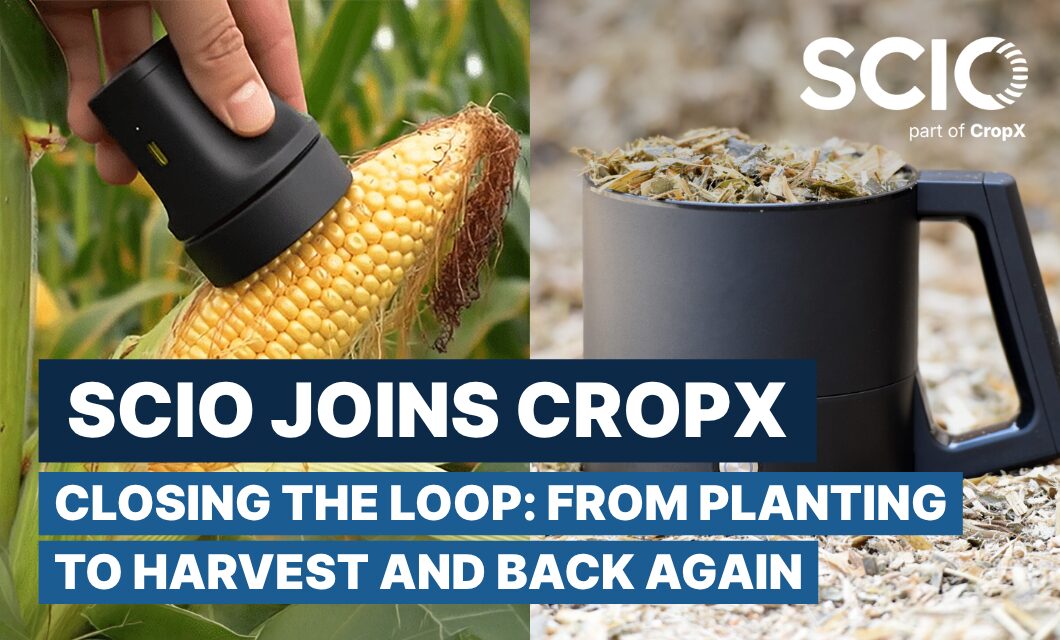
SCIO’s portable near-infrared (NIR) devices measure attributes such as moisture, protein, oil and sugar content without sending samples to a laboratory. Its products include the handheld SCIO Mini, the SCIO Cup for testing grain, and sensors integrated into combines.
For CropX, which has historically focused on agronomic decision-making during the growing season—from irrigation to fertilizer management—the devices will enable it to “close the loop” by connecting agronomic recommendations with measurable outcomes at harvest, said Tzach.
“This will be integrated into the CropX platform and once you start using both, the system starts connecting the dots.”
Drawing causal links between agronomic interventions and crop quality is easier said than done as things like protein levels can reflect multiple factors from weather to soil conditions, acknowledged Tzach.
However, CropX expects the value to emerge from analyzing large volumes of data: “You can only make the connections when it’s at scale.”
Low cost, real time results
Near-infrared spectroscopy is established in agriculture and food processing, but SCIO’s portable tech is smaller, cheaper and easier to deploy in the field, claimed Tzach. “They [SCIO’s devices] cost probably a fifth of anything else that’s out there.”
Because the devices contain no moving parts and can be used in the field, they can dramatically increase the frequency of testing versus conventional lab sampling, he said.
“Now you test all the time, so you get much more data. You can make much more intelligent decisions in places that you could never touch before.”
SCIO’s technology is now used across grains including corn and wheat, animal feed and forage, dairy and cheese, berries and other crops. Its handheld device can assess corn moisture and protein ahead of harvest, while berry applications include measuring Brix, or sugar content, which can influence quality and value.
CropX: ~$20m ARR ‘just around the corner’
CropX is approaching an ARR of $20 million from subscription fees, a number that excludes one-time hardware sales, said Tzach. “The majority of our business is actually software and subscriptions, which leads to a strong gross margin. Many of our use cases don’t require hardware at all.”
But he added: “CropX always believed in a hardware-enabled SaaS model. Our various hardware products—proprietary soil sensors, telemetry, ET sensing, weather stations and now spectrometry with SCIO—are primarily enablers for collecting proprietary data.
“In agtech, we’ve always felt that owning the data collection layer is a significant advantage: it differentiates us from the many software platforms relying largely on publicly available or third-party data, increases customer stickiness once deployed, and often makes the initial sale easier because farmers respond well to something tangible alongside the software.”
For a time, he claimed, VCs viewed hardware “almost as a negative as everyone wanted pure SaaS.” But now, we’re seeing almost the reverse: growing excitement around hardware-enabled software and “physical AI.”
“As software alone becomes increasingly easy to replicate, proprietary hardware and the unique data it generates can actually create a very meaningful moat. Of course, we use AI extensively throughout CropX but importantly, much of it is powered by proprietary data that we collect ourselves and that is very difficult for others to replicate.”
In a call with AgFunderNews in February, Tzach described the business as “very close to profitability” but said the firm planned to extend its Series C largely to fund further acquisitions rather than day-to-day operations. That process is now complete, with an undisclosed combination of debt and equity now secured.
Asked this week when he anticipated CropX would be profitable, he said: “I think probably 2027 is a safe bet.”
Organic vs acquired growth: ‘about 50-50’
CropX evaluates acquisitions partly by comparing the amount it pays for each customer or dollar of revenue acquired with what it would cost to generate that growth organically. If the acquisition cost is lower than CropX’s existing customer acquisition cost, he argues, buying the business can be cheaper than building the same revenue base internally.
“When we look at every acquisition, we ask how much are we paying per customer or per dollar acquired?”
Quizzed on how much of CropX’s growth had come from acquisitions rather than organic growth, Tzach said: “Our growth is about 50-50 organic and inorganic historically.”
Cross-selling opportunities
There are also cross-selling opportunities: CropX can sell its platform to customers of acquired companies and offer newly acquired technologies to its existing customer base, said Tzach, pointing to CropX’s 2023 acquisition of California-based Tule Technologies.
For example, CropX integrated Tule’s evapotranspiration sensor into its own platform and telemetry system, reducing costs and expanding a product previously sold largely in California into international markets, he claimed.
“We added another kind of technological capability. We’re now selling that all over.”
CropX plans a similar integration with SCIO rather than maintaining another standalone software platform. “It will be integrated into the CropX app, and you will get everything there.”
SCIO has a “strong portfolio of enterprise customers” fairly evenly split across the US, Europe and Latin America, while CropX’s customer base is “about 50% US, 25% Europe and 25% the rest of the world,” he explained.
M&A machine
CropX—which has previously pitched itself as an “M&A machine”— will continue to explore acquisition opportunities, said Tzach.
“People approach us at this point when they need a fast deal. They know that CropX is serious, and if they give us a letter of intent, they’re very likely to close on it and execute on it.
“With our previous acquisition, after we acquired them, we learned that we were actually offer number three in terms of size, but the board decided to go with us.”
The company he joined in 2017 “did irrigation management, and only irrigation management,” observed Tzach. “But what we realized early on is that while water is important, it is probably not going to be enough for us to build a venture-backed company that would get to a meaningful size.”
What followed was one of the most high-profile buying sprees in agriculture, with eight acquisitions in six years taking CropX from a precision irrigation startup to a broad “digital agronomy” platform with a “playbook for PMI” (post-merger integration).
CropX acquisitions:
👉 CropMetrics (US) – Jan 2020 – Precision irrigation company, which added 500,000+ acres of in-soil farm data and irrigation expertise to CropX’s platform.
👉 Regen (New Zealand) – Sept 2020 – Cloud-based effluent and irrigation decision support tools.
👉 Dacom Farm Intelligence (Netherlands) – Aug 2021 – Precision ag company with advanced advisory tools and a large customer base in Europe.
👉 Tule Technologies (US) – Jan 2023 – Precision irrigation startup with above-canopy evapotranspiration measurement technology.
👉 Green Brain (Australia) – Dec 2023 – Digital agronomy and irrigation management solutions provider.
👉 EnGeniousAg (US) – Sept 2024 – Nitrogen sensing technology company expanding CropX’s capabilities in nutrient management and precision fertilizer use.
👉 Acclym (Israel) – Sept 2025 – Ag intelligence company with tools to help F&B brands manage sustainability goals and ESG reporting.
👉 SCIO (US) – Aug 2026– Portable NIR (near infra-red) spectroscopy firm enabling pre- and post-harvest quality measurement.