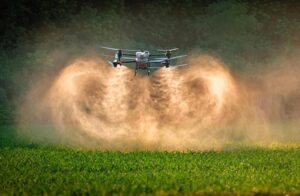
Ag robotics startup TRIC Robotics has moved from half-acre trials in 2021 to treating more than 1,500 acres of commercial strawberries this year with a fleet of 15 autonomous robots armed with UV-C light and bug vacuums operating nightly in California fields.
The firm, founded by Adam Stager, PhD, and Vishnu Somasundaram at the University of Delaware, deploys a robots as a service model that requires no upfront investment from farmers, lowering barriers to adoption and offering a steady revenue stream.
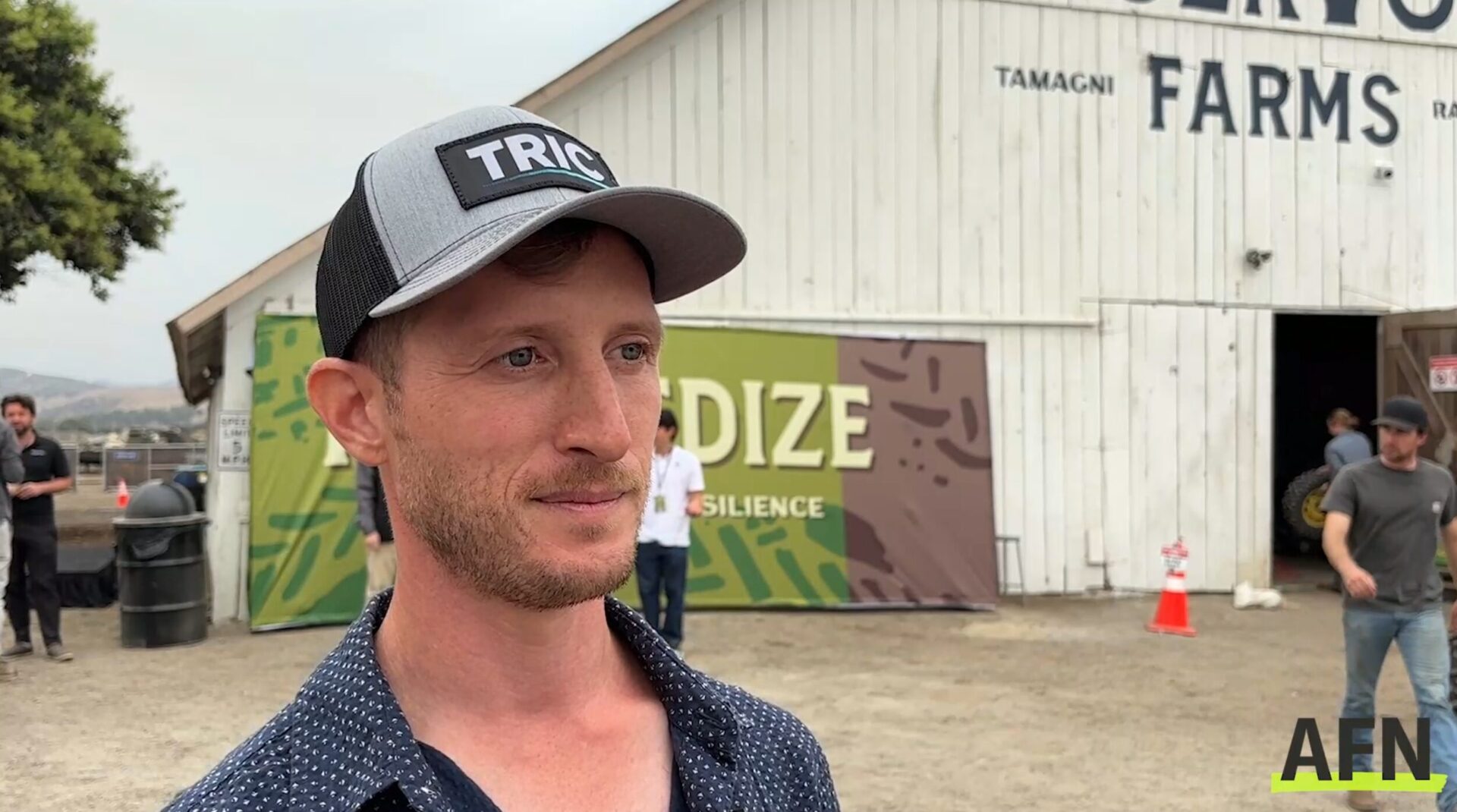
AgFunderNews (AFN) caught up with Stager (AS) at the inaugural Ruggedize ag robotics conference at Reservoir Farms in Salinas to discuss the firm’s latest progress on using light to tackle fungal pathogens, its business model, and how it plans to build a broader robotics platform around its foothold in strawberries.
AFN: What does TRIC Robotics do?
AS: At TRIC Robotics, we’re helping farmers control pests and disease using ultraviolet light and bug vacuums as a replacement for chemical pesticides. So you can think of our company like a fleet of robots that we operate as a service to replace those chemicals.
AFN: There are other UVC light players out there such as Saga Robotics. Are you going after a different part of the market?
AS: Saga Robotics, for example, has a much smaller form factor, and uses battery power, which offers some value to different types of farmers. Whereas for our farmers, it’s really important to cover lots of acres. So we’ve got very big [diesel-powered] machines.
So you can think of Saga [covering] a single row versus a six or more row type machine [from TRIC Robotics]. And because ours is working in [open field] strawberries, the terrain is a little bit different than they have in vineyards [where Saga has been focused in the US]. We’ve got machines with six foot tall tires, 25,000-lb machines, whereas they’re [Saga Robotics] more lightweight.
AFN: What kind of progress have you made so far?
AS: It’s been incredible. Starting on just half acre sites in 2021, now we’re full scale commercial. So this year we’ve done over 1,500 acres of commercial strawberries and we’ve got 15 machines that are out there running every single night.
AFN: What are the biggest barriers to adoption? Are people still wary about whether UV-C tech actually works?
AS: It’s very easy now to make the pitch. Once you get to full farms with some really well-known farmers, other farmers start to talk about that, and they can see the results by just going to the field and talking to farmers that they already know.
One of the best things is it [the TRIC business model] doesn’t require anything from the farmer. Since we operate as a service, they don’t have any upfront capex, and we operate at night out of the way of all the things that they normally do during the day. In strawberry fields, particularly, it’s chaos during the day so it would be pretty hard to integrate autonomy right off the bat. By starting at night, we’re delivering value and introducing farmers to autonomy at the same time.
AFN: You’ve got a robots as a service (RaaS) business model. Can you talk about the pros and cons?
AS: So for the pros, you get recurring business where the farmers come back every year, and it’s really nice if you’re starting out with a new technology because you have a lot of control about how that gets deployed.
One thing that we’ve done with our technology is use UV light first as the wedge to get to market, and because we own all the assets, we were able to add that value right away to our customers and bring bug vacuums as our second solution, without the farmer having to buy a whole new robot.
That helped us get to market really fast, and it works for us because our market in strawberries is extremely geographically dense, which means most of the market is all in one place.
I think in certain crops where the market is very distributed, it makes a lot of sense to make a sale. But in certain crops the farmers don’t really have the budget to buy million dollar equipment. Strawberries is one of those crops where they typically have smaller tractors, so there’s a lot of market dynamics that go into which model you choose.
Strawberries is one of those places where since farmers pay per application per acre for their [spraying] service today, service [with UV-C light] is something that fits directly in their business model, whereas other farmers do typically buy equipment, so it’s a little bit different.
AFN: What’s the business case for the farmer?
AS: We charge about what farmers pay today [for spraying fungal pathogens], and the plants are physically healthier. We also see that for our farmers their season lasts longer because they have healthier plants. So there’s a lot of benefits. Of course, there’s also just the pure cost saving from not spraying chemicals.
As an example, the California Strawberry Center did a case study with us. We didn’t even ask them to do this, they just did this independently. And what they found was our vacuum alone pays for both the vacuum and the light service. It’s actually worked so well that the farmers started trying to treat three times a week, and they normally only do two. It’s a really good deal when you start bundling services on top of autonomy.
AFN: How has your machine evolved since you started out?
AS: We started with very small golf cart size machines that I built in the garage, and those did not last very long. When we talked about economics with farmers, they said if you’re going to make any money, you need to cover lots of acres, and our machines were so small that they were getting stuck in all the little ditches in the field.
We worked with Andros Engineering to really scale things up, so we took the same form factor and made it tractor size, and that helped it get through the field very well.
We also automated the boom, as we realized that with dosing UV light, it was really important how high the array was off the plants, and with all that field variability, you really need to be able to adjust that boom. So we adjusted as we went, iterating on that design as fast as we could to find the right solution with the farmer instead of doing it all in the lab.
AFN: What’s the addressable market for your product, and is it wide enough for TRIC Robotics to be an investable proposition?
AS: We’re focused on the wedge today because we can get to that market very fast, and we’re still talking about hundreds of millions of dollars. But what’s really amazing is by profitably scaling a fleet of robots on the farm, you can start to stack capabilities on top of that, and that’s how our existing market becomes a billion-dollar opportunity. We can also start to expand with UV as a wedge into other crops in parallel.
So there are multiple ways we can go, starting with a profitable foundation. We can scale with strawberry growers and add new capabilities. We can scale into new crops, and then of course international expansion with our existing customers.
AFN: What other things beyond UV light can you tack on to your machines potentially?
AS: They already pay as a service, and we just replace that line item directly [with UVC treatment for fungal pathogens]. But there’s a lot of other things that are very, very simple that they do on the farm. The simplest of which is some farmers actually take metal skis and drag them in the furrow to flatten the dirt out, so people don’t trip. So there’s a liability issue there.
In Oxnard, they run a tractor through the field [to flatten the dirt] once a week. So [being able to get TRIC machines to do] this is maybe of small value from a financial standpoint, but a huge amount of value from a stickiness and value to the customer standpoint.
So I think let’s start with the easy things, and then we can start to climb that difficulty curve and eventually start solving some of the harder problems. In our case, there’s weeds that grow next to the strawberry plant. Starting to pull those weeds would double our revenue.
B-roll courtesy of TRIC Robotics.
Further reading:
🎥‘The whole system is now more investable’: Reservoir makes the case for ag robotics
🎥 Carbon Robotics: $100m+ revenue, new machine and a path to IPO
🎥 From 2D images to 3D worlds: Bonsai bets on AI-powered farm robotics
Castoro Cellars deploys Saga Robotics’ UV-C bots across 600 organic acres