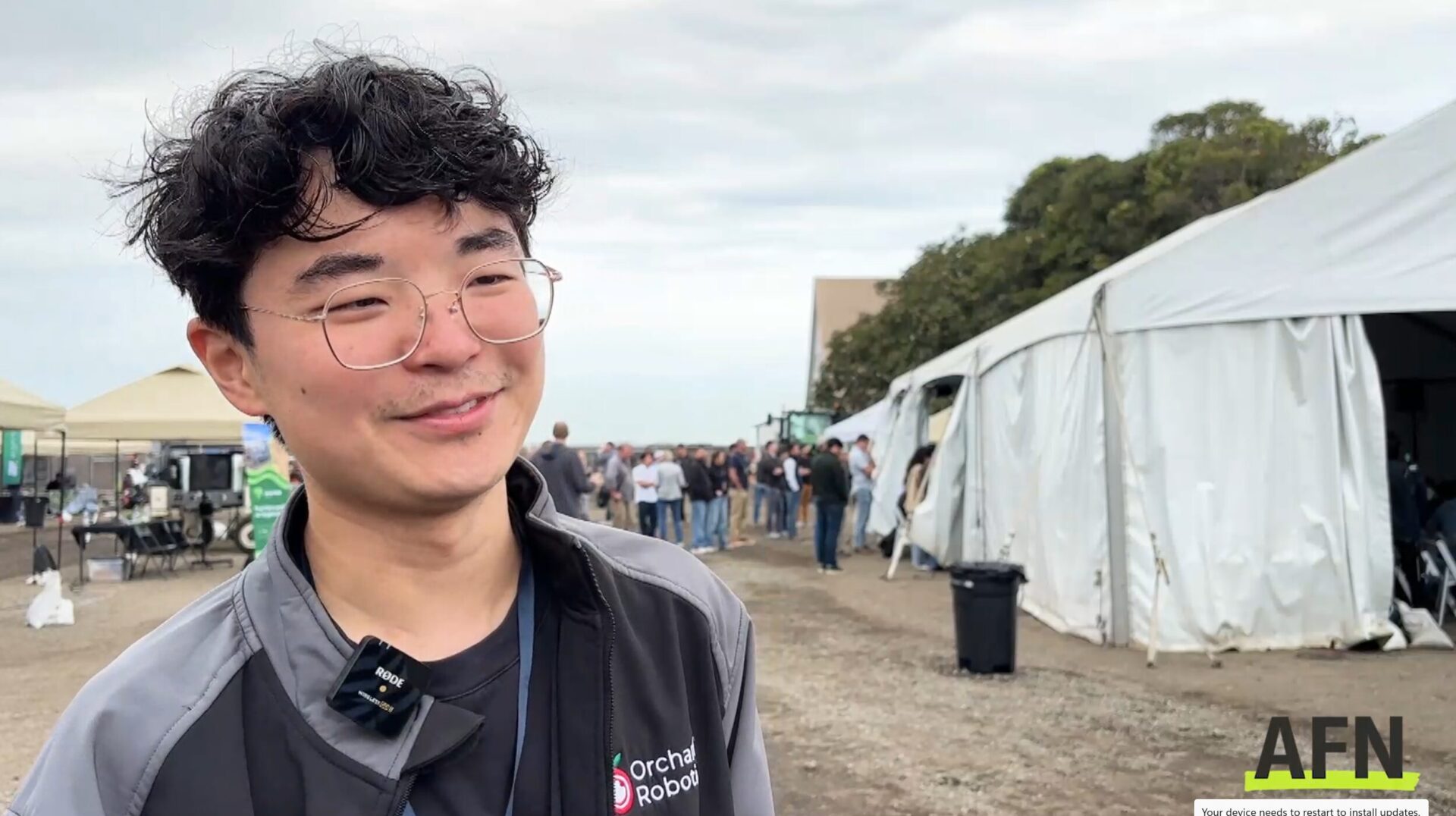
“A million numbers in a spreadsheet is not a product,” observed Orchard Robotics founder and CEO Charlie Wu on stage at last week’s Ruggedize ag robotics conference at Reservoir Farms in Salinas.
“Data is only useful if there is an actual use for that data, and it’s not just a fancy map on screen. Data is only useful if a grower has a mechanism of taking an action on that data easily. Your average grower does not want to be, nor should they be, a data analyst.”
The firm, which has an AI-powered camera system that mounts onto tractors and other farm vehicles and captures millions of images as they travel through orchards and vineyards, can measure everything from fruit counts, size and color to growth rates, canopy health, water stress, disease and yield.
Images are processed on an onboard NVIDIA Jetson computer because many farms lack the connectivity required to upload terabytes of raw imagery. The resulting information feeds into Orchard’s FruitScope platform, where growers can inspect conditions down to the level of individual trees, said Wu.
“We’re not actually selling hardware. We’re not even selling software. We’re not even selling data. We’re selling the outcome that a grower sees by using all of it effectively.”
While some farms have precision sprayers and spreaders that can automatically vary applications based on insights from Orchard’s platform, others opt to receive instructions directly to workers in the field via a mobile app showing them where to go and what action to take.
“The biggest ROI is through reduction on labor and inputs,” Wu told AgFunderNews. But supply-chain planning is another significant source of value. As the platform can predict yields with 95%+ accuracy, this can inform decisions around how much labor to hire, how many bins to procure, storage requirements and what sales and marketing teams can promise customers.
Orchard started in apples but has since expanded into grapes, cherries, blueberries, almonds, pistachios and citrus, and is now moving into new crops including pomegranates, coffee, and strawberries.
It currently has “hundreds of systems in the field” and is scanning tens of thousands of acres, with ambitions to reach hundreds of thousands.
Most customers are currently in the US, but Wu says Orchard is also seeing “some pretty tremendous pull internationally.”
AgFunderNews (AFN) caught up with Wu (CW) to discuss the pitch and the ROI: “When we sell our product, we don’t actually claim to boost yield. We pitch them on the labor savings, the input savings, and supply chain efficiencies, and we say, ‘Hey, you know and I know that if you do all these things correctly, you’re going to see an increase in yield.’
“In the first year, if a grower sees full value from labor and input savings, they can see anywhere from three to 10x ROI.”
AFN: What does Orchard Robotics do and what data are you collecting from farms?
CW: First, we build an AI-powered camera system. It’s about the size of a large tissue box and weighs about five pounds. It goes onto any sort of tractor or farm vehicle. So as you’re driving your vehicle down your rows past your trees, we’re taking millions of pictures.
We can measure pretty much anything that’s visible, from fruit counts, fruit sizes, color, growth rate, the health of the leaves, disease detection, accurate yield estimates, size estimates, inventories, all these things. It’s a lot of data about billions of fruit and millions of trees.
It all goes into a platform that we’ve built that lets our growers log in, look at all their data, understand their farm, predict their yield, know where they need to deploy more or less labor or inputs and really be able to you know operationalize the information we provide them.
AFN: Can you give me a few concrete examples of how you’re collecting a particular piece of data and how you can turn that information into insight and then action?
CW: Probably the simplest is fruit count. We can tell a grower how many fruit there are in every tree. In a lot of tree fruit, they do pruning and thinning, which is basically reducing the number of fruit per tree. You want to take off more fruit on the trees that have more, less fruit on the trees that have less fruit.
And oftentimes there’s a big variation. Half of the trees in a block might have double the amount of fruit vs the other half. So you need to know where you need more labor, where you need less labor.
The biggest ROI is through reduction of labor and inputs, knowing where you need more, less, or maybe nothing at all, and knowing what that distribution looks like across the field, across a block, across a ranch or a farm, and then also through supply chain insights.
So we can predict yield for growers with 95% accuracy or beyond. That’s really helpful, knowing how many people do I hire, how many bins do I need, what do I tell my sales and marketing team? All these things are really valuable to know exactly what your yield is going to be and what a distribution of sizes are going to be, so you can plan for the future.
AFN: How do you communicate the info and insights to growers?
CW: We have a phone app that lets you send the information to any worker in the field. That’s been the primary mode of action, just because right now it’s not like a lot of growers have precision sprayers or precision spreaders. But for the ones who do, we build integrations with them. And for the ones that don’t, we make it easy just via a phone app.
AFN: How often does a grower need to scan the field for the system to be useful?
CW: It really depends. We have some growers who scan five times a year and some who scan a single field 25 times a year depending on what they want to see and when. Our average is usually around ten-ish times in a season.
AFN: Who owns and operates the camera system? How does your business model work?
CW: We have a self-serve model and a full service model. Some of our growers want the camera. They want to put it on their own vehicles, and they want to use it in their day-to-day operations, which is really helpful if you have nsay a tractor that’s mowing or spraying. Just put that camera on that tractor; it’s going through already. You’re collecting that data as you go.
But we also have some growers who say, you know, I don’t want to deal with data collection. I want you to go in and scan it for us, so we offer a full-service option where we have our own technicians. So here,, the grower says I want data for this field and we go out to that field, scan it, and the very next day they have the information and they can go and use it.
So we provide flexibility to our growers to be able to do whatever they feel best fits their operation.
AFN: What’s the pricing model?
CW: The pricing model is a per acre per year subscription fee. So it includes everything, including the software platform, unlimited scans, and access to the hardware. The reason we price it like that is because we’re constantly improving the hardware.
Whenever we come out with a new version of the camera, the grower gets that upgrade for free without having to have to deal with either having an obsolete system or having to buy a new one.
AFN: You started with apples. Does this tech translate to other crops? And how much time and training does it take to move from one to the other?
CW: We’ve gotten really, really good at going to new crops. We now work in apples, wine grapes, table grapes, cherries, blueberries, almonds, pistachios, and citrus. And we’re growing to some new ones as well including pomegranates, coffee, strawberries, and some other new crops.
Our team has gotten really good at training new AI models. We’ve seen a lot, and there’s a lot across different crops that are the same, which means our AI models are able to learn across the board and get better with every new crop, with every new farm that we see.
AFN: How widely adopted is your tech now?
CW: We hope to eventually one day service every specialty crop out there. We have hundreds of systems in the field. We’ve been growing multiple times year over year over the last few years, and we’ve you know been scanning tens of thousands of acres, soon hopefully to be hundreds of thousands of acres.
Right now, most of our customers are in the US but we’ve been seeing some pretty tremendous pull internationally, and we’ve been expanding pretty rapidly internationally as well.
Further reading:
🎥‘The whole system is now more investable’: Reservoir makes the case for ag robotics
🎥 Carbon Robotics: $100m+ revenue, new machine and a path to IPO
🎥 TRIC Robotics scales to 1,500 strawberry acres with 15-robot fleet
🎥 From 2D images to 3D worlds: Bonsai bets on AI-powered farm robotics