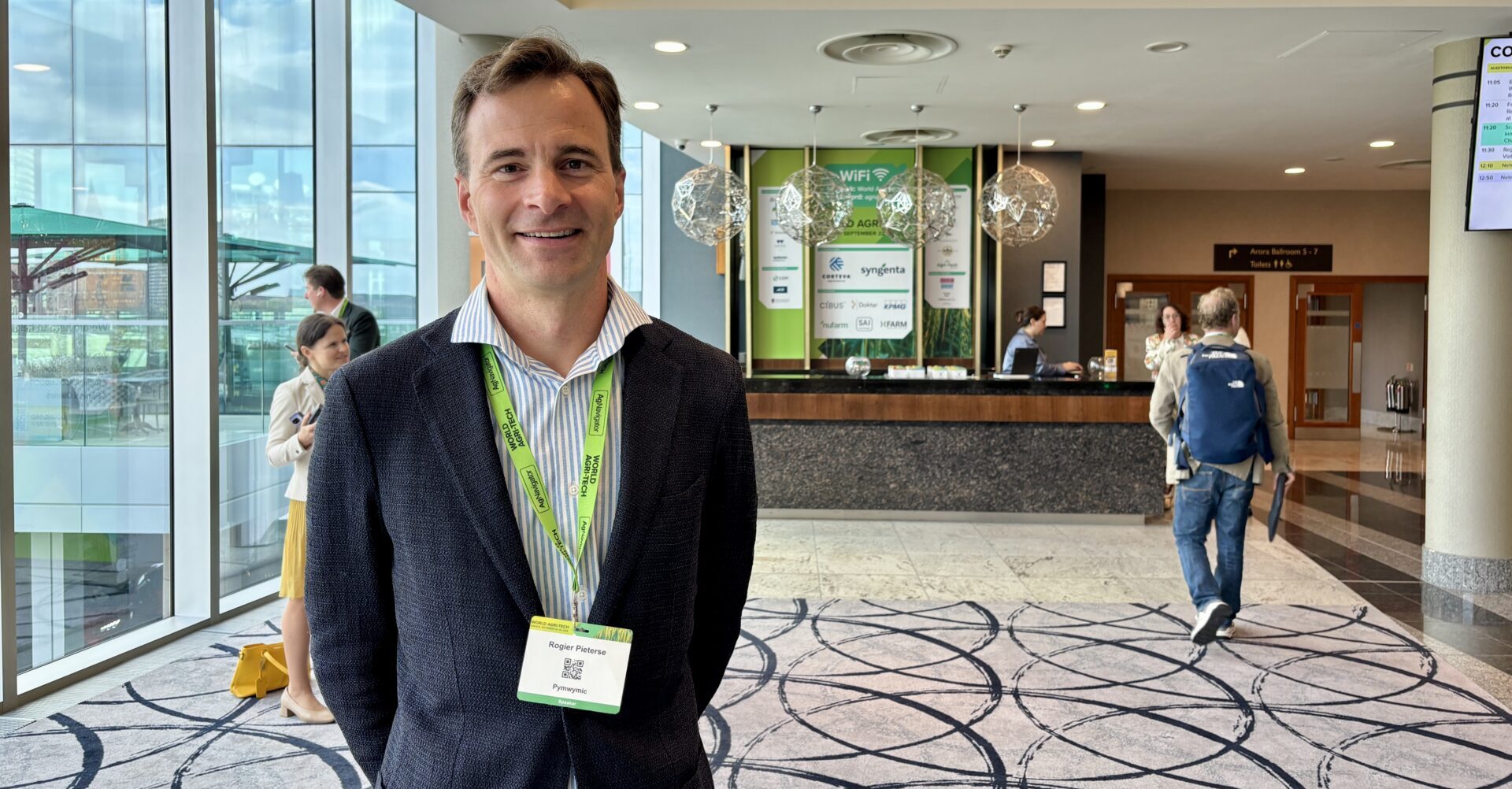
In agrifoodtech investing, says Pymwymic managing partner Rogier Pieterse, it might be time to stop shooting for the stars and instead aim for the moon — and consistently land there.
“We don’t believe in what we call the US VC model, where you invest in one or two winners, which are then supposedly going to return your fund.”
Meanwhile, corporates will need to provide more support to the sector, he says. “I believe corporate ventures will need to take that innovation risk a bit more, and then private equity growth capital will come in later to accelerate that growth.”
AgFunderNews (AFN) caught up with Pieterse (RP) at the World Agri-Tech innovation summit in London to discuss why Pymwymic is targeting more modest but consistent returns, the funding gap facing agrifood startups, and where he sees opportunities in areas from precision agriculture and biologicals to robotics and AI.
AFN: You’ve challenged the Silicon Valley model of VC investing for agrifoodtech?
RP: We don’t believe in what we call the US VC model, where you invest in one or two winners, which are then supposedly going to return your fund. We believe in investing in not per se just one winner, but in what we say the middle layer, and trying to avoid losers.
We are not looking for 10x, 100x return expectations when we do an investment, but like on average, just having a reasonable margin, so 10% or so. That’s what we promised to our investors.
AFN: If returns of 10% are acceptable and we need to reset our expectations, with that kind of proposition, can you attract enough institutional capital from LPs?
RP: It is a challenge, especially nowadays, where institutional investors say, well, we want to have at least 15%. I always challenge them: so in all the other investments that they have done, how many of those funds actually delivered on that promise?
So far, which makes us quite unique, we have been able to create a proper DPI, so funds returned to our LPs in this apparently tough market, and also we are still on the trajectory to meet our 10% which we have promised.
Obviously, it also helps that we have quite a strong private investor base, which supports all our funds as a cornerstone investor [the Pymwymic Coöperatief an investment coop made up of private investors: families, family foundations and selected individuals]. But still, 11 years down the track, we feel that we have a certain credibility and certainly the new LPs that come feel like Pymwymic provides them a safe haven.
AFN: When you’re thinking about who’s going to fund the next round for your portfolio companies, are you encouraged by what you see or worried?
RP: Let’s start with the fact that there’s less capital available for these types of innovations now. The environment we are in nowadays is way more short-term versus long-term focused. The fact that there are fewer investors in this space, and especially in the early or still loss-making phase, provides us the opportunity to invest at a better entry point, so there is the economic reasoning of buy low, sell high.
But obviously, there are concerns for follow-up rounds. So what we have done to mitigate that is we’ve just added an evergreen growth fund to our platform, which is more focused on profitable businesses [the Pymwymic Healthy Food Systems Growth Impact Fund III, which Pymwymic launched in 2026 by taking over the Triodos Food Transition Europe Fund]. So what we hope is that the ventures that are successful in our early-stage funds can roll over to the growth portfolio. And that fund is evergreen, so it allows us to stay in longer because what we see in this market is that it simply takes more time for companies to flourish [the fund doesn’t have a fixed end date in the way a typical VC fund does].
AFN: Five years from now, will there be fewer dedicated agri-food tech VCs? More corporate capital? Different funding models?
RP: I think there is no way around it. Yesterday in a panel I was in on stage, I mentioned that more corporate venture [funds] will need to step in earlier, which currently is not happening. In fact, it’s now the other way around, where venture has been taking this initial development risk and then later on tried to access corporate venture money.
I believe corporate ventures will need to take that innovation risk a bit more, and then private equity growth capital will come in later to accelerate that growth. That’s what we’re now trying to solve with this platform play that we are implementing within Pymwymic. For all our venture plays, we want to have strategics on the cap table.
AFN: Are there certain areas that you would have invested in three, four years ago that you wouldn’t touch today?
RP: Our thesis hasn’t changed. We have always had the approach of under promising and over delivering and we haven’t luckily been dragged into many rat races on vertical farming or alternative proteins, and always stuck to the idea that we need to enter into portfolio companies at a low valuation point.
We never felt the urge around this total addressable market promise [startups pitching on the size of a theoretical market opportunity]. We’ve always looked at true farmer adoption or unit economics, that is still the same.
Yes, there have been markets where probably four years ago, I thought they were amazing, and now I’m thinking that’s scary. But everything goes in cycles, right? Things change and things evolve. So last year we actually made our first alternative protein investment against the cycle, which four years ago I never would have done. But we have learned many lessons [in that market segment] over the past few years.
AFN: Are there any agrifoodtech areas you’re particularly excited about, or that you feel are currently underfunded relative to the potential opportunity?
RP: I don’t believe that this input-driven system as it is right now, will last forever. You’re putting in $100 million of inputs in the ground and getting $80 million out of it, which is economically not sensible.
If you look at precision farming, precision spraying, but also nutrient management, the soil contains the signals that farmers need to make the right decisions. So that is the bet that we are currently placing. On top of that, if you think about underfunded areas, I’d say regenerative practices, and that is something we are trying to support.
But we also realize that we are in a transition period. So things will take time, like renewables did, and the trend towards biologicals also will come.
AFN: Is the ag robotics space becoming more investable now?
RP: It’s becoming more driven by off-the-shelf components, so unit prices are going down. Data usage and artificial intelligence also help. Still, the brutal fact for robotics is that when you speak to a farmer, he or she will still say that the actual reality of, for example, autonomous driving is a bit more brutal, whether there’s irrigation lines still laying on the field, which prevents a robot from passing, or the robot doesn’t recognize that an implement is heating up because there’s a rock stuck [in the field].
So it’s getting there, it’s getting more investable, but I think the fact that there’s still human intervention needed can still hold true scaling back.
AFN: How is AI changing the space in your view? And how, as an investor, do you think about what is a moat versus what anyone can now do in-house with the available AI tools?
RP: Our portfolio is 75-80% hardware-software, data driven. So the quality of the data and the uniqueness of the data is often the defensibility of a business.
What a company can do with a data set and how it has been historically annotating data, recognizing one specific pest versus the other, makes it unique, and especially when it can translate it to a specific actionable insight for a farmer.
👉 Read more interviews in our Investor Q&A series.