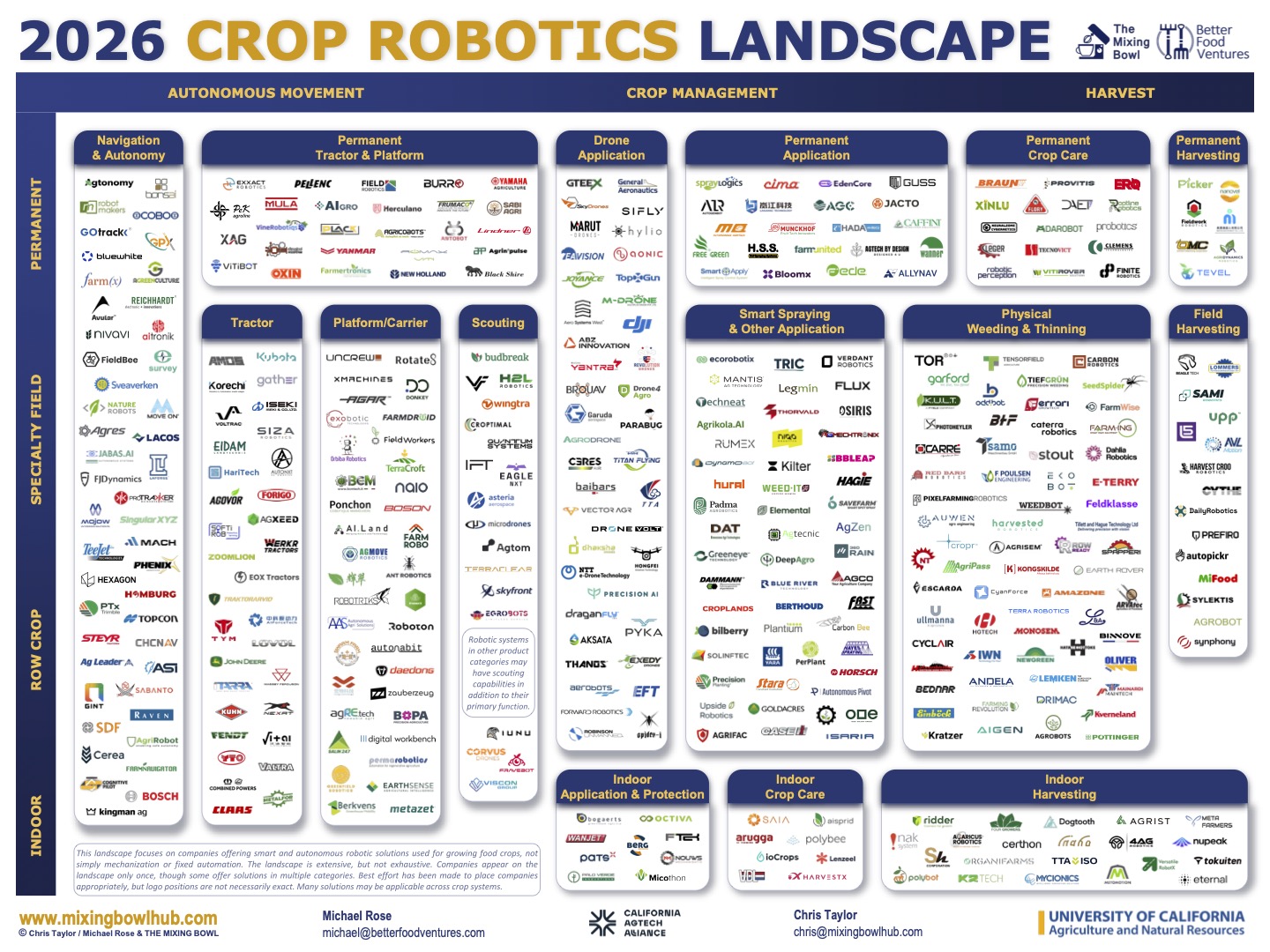
It’s still early days for the “robotic revolution” in agriculture, according to agrifood innovation hub The Mixing Bowl and its latest Crop Robotics landscape report.
Originally launched in 2022, the landscape tracks such companies, this year across across 15 segments including weeding, harvesting, tractors, autonomy, and scouting, to name a few. (The landscape does not include nursery or post-harvest segments.)
The 2026 Crop Robotic landscape includes 400 companies, a 25% increase from 2024. Those numbers come with a caveat, however, said Chris Taylor, a partner at the Mixing Bowl. “There’s some churn in that 20% of the companies are no longer there that were there before, and more than a third on [the most recent] landscape are actually new to the landscape.”
This indicates a dynamic and active innovation environment, but also one that is extremely competitive and often difficult, he adds.
Europe as a region accounts for half the companies in the landscape, while the US leads on individual countries, representing 18% of total companies. More than 40% of those US companies are based in California.
Investments, while nowhere near the peak of 2021, have remained steady. According to the report, companies included have collectively raised $600 million, from early seed rounds to raises north of $100 million.
What’s tracking
Spraying and weeding continue to see steady growth and, as Taylor points out, are some of the most popular areas for venture investing.
“We’ve seen a lot of great commercialization there,” noted Western Growers’ Ben Palone, speaking at the recent launch event for the Crop Robotic landscape.
“Quite honestly, I’m happy where we are in the commercialization stage with weeding. We’re getting [further] into the adoption phase, but now we’re seeing some market competition between companies, and it’s actually shaken up a little bit of the business models at a few of those companies.”
Elsewhere, major equipment manufacturers — think Yamaha, Deere, Caterpillar, and Kubota — have acquired companies or assets, or struck partnerships with robotics startups to bolster their own portfolios.
For example, Kubota led an investment into precision sprayer Kilter earlier this year, while Deere in 2025 acquired GUSS, maker of semi-autonomous sprayers. Deere also has an exclusive, $10 million partnership with ag robotics incubator Reservoir, among the company’s many other startup-related activities.
“There’s no question that the OEMs see that there is a future in this,” says Taylor. “How they’re getting there, whether it’s M&A of full companies or acquisitions of technology or partnering, there are different paths they’re taking but they’re all heading in that direction.”
Elsewhere, some of the better-funded startups are absorbing their peers, such as Bonsai Robotics scooping up Farm-ng and FarmX buying AMOS power.
“These M&A activities are not signs of a maturing market so much as an early-stage market concentrating its capital and talent,” notes Taylor.
What’s still challenging
As it has been for years, harvest is still one of the most challenging categories in terms of both technical capabilities and scaling.
“It’s the hardest area in crop robotics, and it continues to lag the others. But remains the holy grail of what’s trying to be accomplished,” says Taylor.
From a purely technical standpoint, machines must ideally be able to identify the crop properly, find it in the plant canopy, then pick it without damaging the fruit or vegetable.
“You have to bring together so much technology to make that happen,” explains Taylor. Oftentimes, it has to be very crop specific as well.
Even with challenges, there are plenty of external elements driving momentum in crop robotics, not the least of which are labor shortages, increasing input costs, and a changing regulatory environment around crop protection tools.
Certain technologies, such as AI tools, play a big role in growing and scaling robotics offerings, though Taylor is quick to point out that “modern machine learning predates the current AI moment by a decade, and computer-vision models have been trained to tell a weed from a crop for some time.”
The bigger changes involving AI will be in “advancements in the underlying technologies” that allow systems to be developed faster, faster application across farm environments, and machines that are “less reactive and more predictive,” says Taylor.
“Crop robotics will continue to be a beneficiary as well as a driver of that advancement.”