Robots can now spray crops and zap weeds with centimeter-level precision. But ask one to pick oranges and the challenge is immediately apparent, says Israeli ag robotics startup Nanovel.
Citrus fruit can sit up to 1.5 meters inside dense foliage, requiring an autonomous harvesting system to identify fruit, leaves and branches in 3D, navigate through the canopy, move material out of the way and then harvest… all without damaging the fruit.
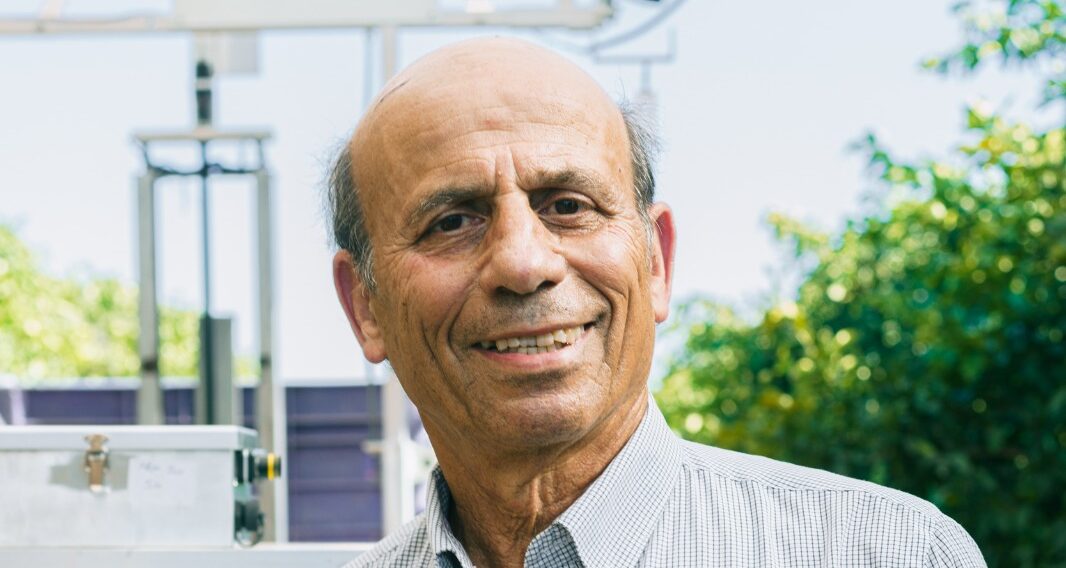
As a result, harvesting these kinds of specialty crops remains one of the toughest nuts to crack in ag robotics, says Nanovel founder and CEO Isaac Mazor.
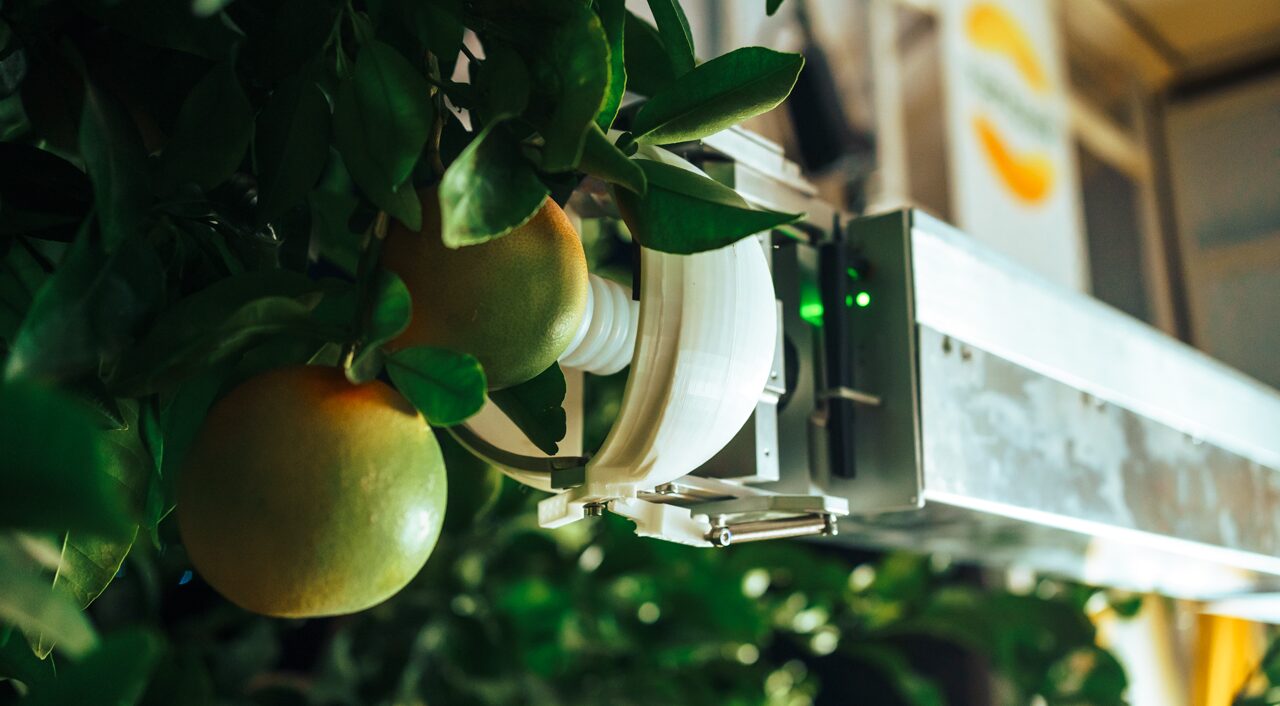
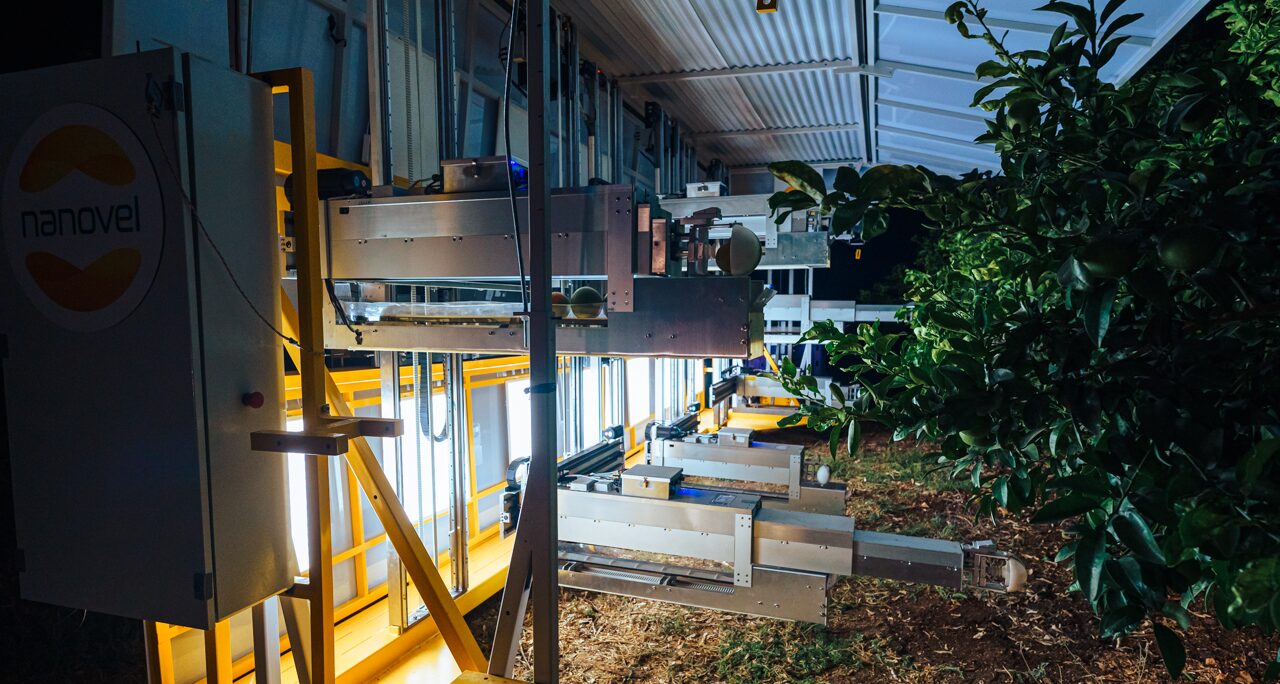
Founded in 2018, Nanovel has spent several years refining a patented autonomous harvester with robotic arms designed to reach deep inside citrus trees, grip fruits with a vacuum gripper and cut their stems less than 2mm from the fruit before conveying them into bins.
The current model uses six telescopic arms operating simultaneously, coordinated by an onboard computer that uses computer vision and AI to map the canopy, allocate fruit between the arms, and avoid collisions. The computer is linked to a remote management system that supervises a fleet of ‘bots.
The vision system can select fruit by color and size, allowing growers to avoid harvesting fruit that would be rejected at the packing house, but does not yet do defect detection.
Following a seven-week trial at a leading grower in California last fall with the Citrus Research Board featuring a tractor-pulled version, the firm is now building a self-driving model.
Trials are planned with leading growers in southern Europe in 2027, with pilot deployments in 2028 and commercial deployment in 2029, says Nanovel, which has just secured a €2.5 million ($2.9 million) grant from the European Innovation Council (EIC) Accelerator program.
Why it matters
While high-tech harvesting might sound pricy, manual labor can account for 50% of production costs in citrus, where growers are highly dependent on seasonal labor, says Mazor.
“One of the reasons we picked oranges is that a substantial amount is grown in countries that are labor sensitive. Even in Brazil, where the labor cost is lower than in the US or Europe, they have severe logistic problems as the growing areas and the populated areas are very far apart and they have to move thousands of pickers back and forth and accommodate them.”
In the US, he says, “manual citrus harvesting costs around $42–43 per 900-lb field bin, versus $25-30 using our technology.”
But direct labor savings are not the only metric that counts, he says. Predictability is also core to the value proposition. Having a robotic harvesting fleet means a grower can schedule harvests without worrying whether enough seasonal workers will turn up. The ‘bots can also operate for longer periods and resume quickly after bad weather.
“The number one criteria is quality,” says Mazor. “If you don’t meet the quality, you’re out. But once you meet the quality, what is really important is the ability to plan ahead.”
Tech can triple or quadruple productivity of one operator
While a robot cannot match the number of oranges that a human can easily pick from a tree, productivity matters more than pushing the machine to retrieve every difficult-to-see fruit, says Mazor.
“The optimal combination between autonomous and human harvesting is a machine that takes 70-80% of the fruit and then the rest we leave to the operator, who is an additional resource to pick the 10-15% of the fruit that are very difficult to cut.”
The aim is to triple or quadruple the productivity of one operator, rather than remove that operator altogether, he says. “We’re not offering a labor free solution. You can imagine a fleet of 10-20 robots and each one is escorted by an operator.”
The operator would also approve movements between picking positions, replace bins, clear occasional obstructions and decide when the robot should move on, he says, with training taking less than a day.
“Gen II is self-driving so the operator can stand at the back. The robot can move autonomously to the next station and the operator can pick the section that the robot just picked and get the leftover fruit.”
Longer term, Mazor hopes to generate a second revenue stream from data gathered during harvesting that can create high-res orchard maps capturing information such as fruit size and sugar content.
This could then be correlated with irrigation, chemical applications and other agronomic inputs.
$400,000 machine, initially sold outright
Nanovel plans to sell the robots outright rather than offer harvesting-as-a-service, reasoning that large citrus growers can use the equipment for 8-11 months of the year and will therefore want to own the asset.
Each machine will likely have a selling price of around $400,000, with payback in under five years, a number Mazor predicts will go down as the machines improve.
“In Europe, in the last 10 years, they lost a lot of their agricultural labor and the average cost of labor is going up every year, so even if the payback is five years, it’s still appealing as otherwise they cannot pick the fruit. But of course we’re not sitting on our hands so our numbers will continue to improve.”
Nanovel envisages using manufacturing/assembly partners in markets such as California, Spain, Italy, Taiwan or Australia, combining a global component supply chain with final integration closer to customers to reduce shipping costs, says Mazor. “This is a big machine.”
The plan is to sell through local dealers/distributors, which would also provide maintenance and servicing supported by Nanovel subsidiaries in key markets.
Citrus first, other tree fruits later
Nanovel is deliberately focusing first on oranges and lemons, which Mazor estimates represent an addressable harvesting market of around $1.5 billion in its target geographies. After establishing the platform there, it could later move into clementines, avocados, mangoes and potentially other fruits.
In the short term, Nanovel is focusing on the US and southern Europe, where labor availability and costs make automation particularly compelling, although Mazor has also had inquiries from Argentina, Chile, Peru and Brazil.
Continuous improvement
Stepping back, Mazor is candid about the fact that the recent California trial was as much a learning exercise as a validation.
“What we have learned through this, of course, is that we have a lot to fix in terms of robustness and productivity. But we are also doing something new.”
While companies including Vision Robotics have developed robotic citrus harvesters, no one has as yet commercialized an autonomous fresh-market citrus harvester, he says.
“The number of harvesting robots for the fresh fruit market, rather than greenhouses or cultivated trellis type growing is very few. There are several [robotic harvesting systems] for apples, but these are often picked by twisting, not by trimming. When it comes to citrus, we are a pioneer.”
The path to profitability
In the first four years, says Mazor, “It was just me and some engineers, and that means we have we able to get to this point with less than $10 million.”
And this pales in comparison to what some other ag robotics players have raised, he said. “[California-based ag robotics startup] Advanced Farm Technologies, which shut down last year, raised over $30 million [for its robotic strawberry and apple harvesting tech].”
The €2.5 million EIC grant also includes eligibility for an equity investment of up to €4.3 million, intended to anchor a planned funding round of around €8 million, he said.
With that additional funding, he predicted, the hope is that Nanovel “can go all the way to break even and make some positive cash.”